Epoxy flooring Huntington, NY
Epoxy Flooring Installers in Huntington, NY
The median year built of the Town of Huntington's housing is 1963 (Census Bureau, 2020-2024 American Community Survey). We test every slab for moisture before we choose the coating system for it.
- Slab tested for moisture before coating
- Diamond ground to profile, not acid etched
- Cure times in writing, from the data sheets
In brief
What epoxy flooring is, what it costs and how we work
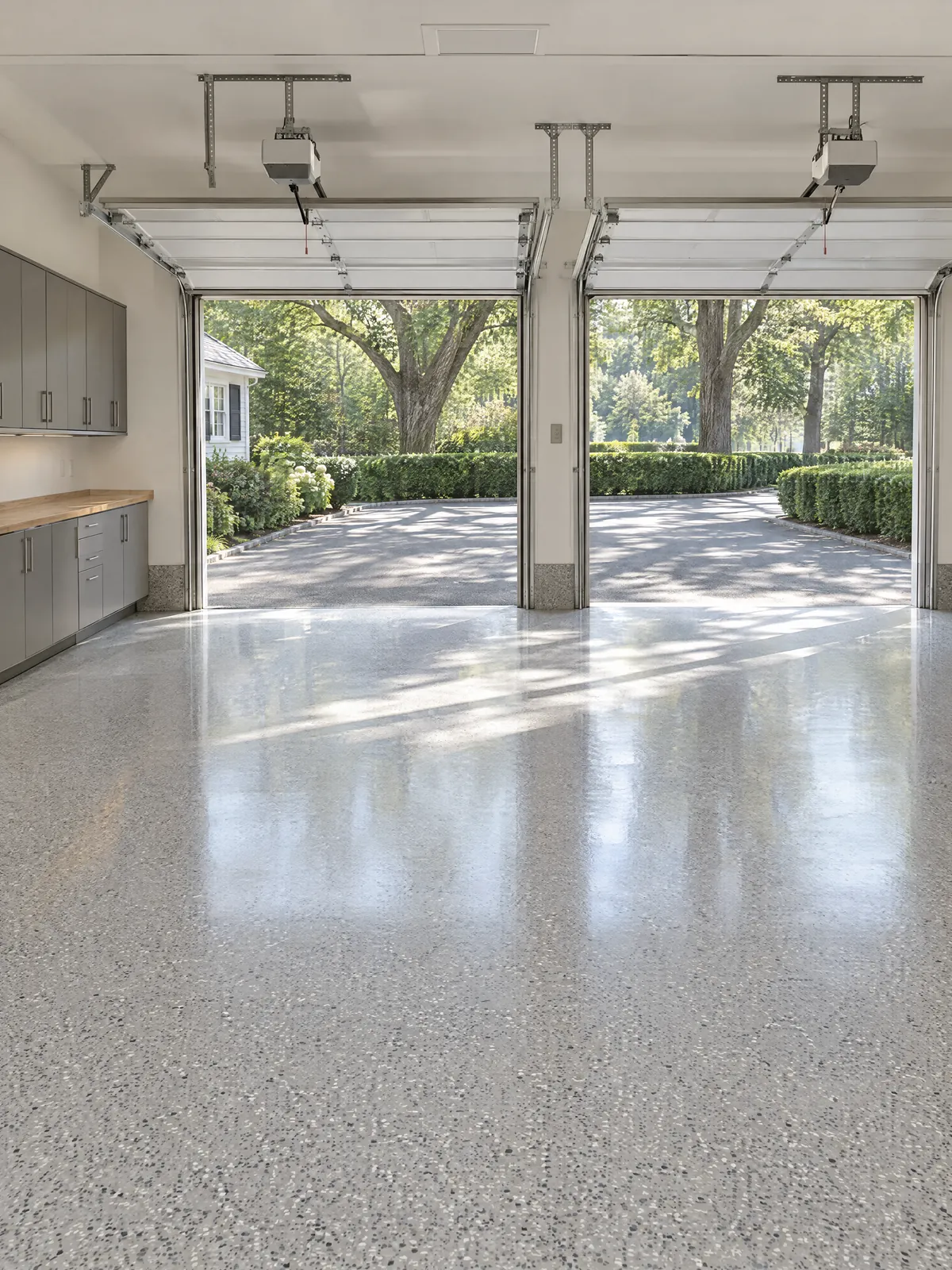
Epoxy flooring is a two-part resin floor: a resin and a hardener, blended on site, cure by chemical reaction into a film on a prepared concrete slab. That is what separates a coating from a paint. Stonhard, a resin floor maker, writes that epoxy paints "rely on a drying process that involves the evaporation of solvents", while epoxy coatings "undergo a chemical reaction known as curing". We install more than one system in the Town of Huntington's garages, basements and commercial buildings: a two-part epoxy base coat with vinyl flake broadcast into it while wet, under a clear polyaspartic topcoat; a system of polyurea and polyaspartic, resins that cure faster than epoxy, for a floor that must return to service quickly; a moisture-mitigating epoxy primer beneath either, where the slab calls for one; and solid-color, quartz and metallic finishes.
What an epoxy floor coating costs is published, as national ranges. HomeGuide's survey dated February 3, 2026, prints $4 to $10 per square foot installed: $1 to $5 for materials and $3 to $5 for labor. Angi's August 2026 data prints $2 to $12 per square foot installed and names the type of resin, the size of the floor and the surface preparation as what drives most of the cost. No survey publishes a price for Huntington, Suffolk County or Long Island, so these are national figures, and none of them is our price. Our cost page sets the surveys side by side, each with its date, and works the arithmetic for a floor of your size.
How we work does not change from floor to floor. We visit, measure and test the slab before we send a free written quote, and the system we quote follows from the moisture reading, the temperature, what the room is used for and how soon you need it back. We grind with diamond tooling instead of acid etching, repair cracks, holes and a scaled surface before the primer, and measure the air temperature, the slab temperature and the dew point, the temperature at which moisture condenses, before we mix: Sherwin-Williams' application instructions for its Resuflor Deco Flake SB system require a substrate at least 5 degrees F above the dew point. If you are comparing epoxy floor installers, ask each for four things in writing: the moisture test, the preparation method, the products by name and the cure times.
Our services
Ten services, from garage floor epoxy to concrete resurfacing
-
Garage Floor Epoxy
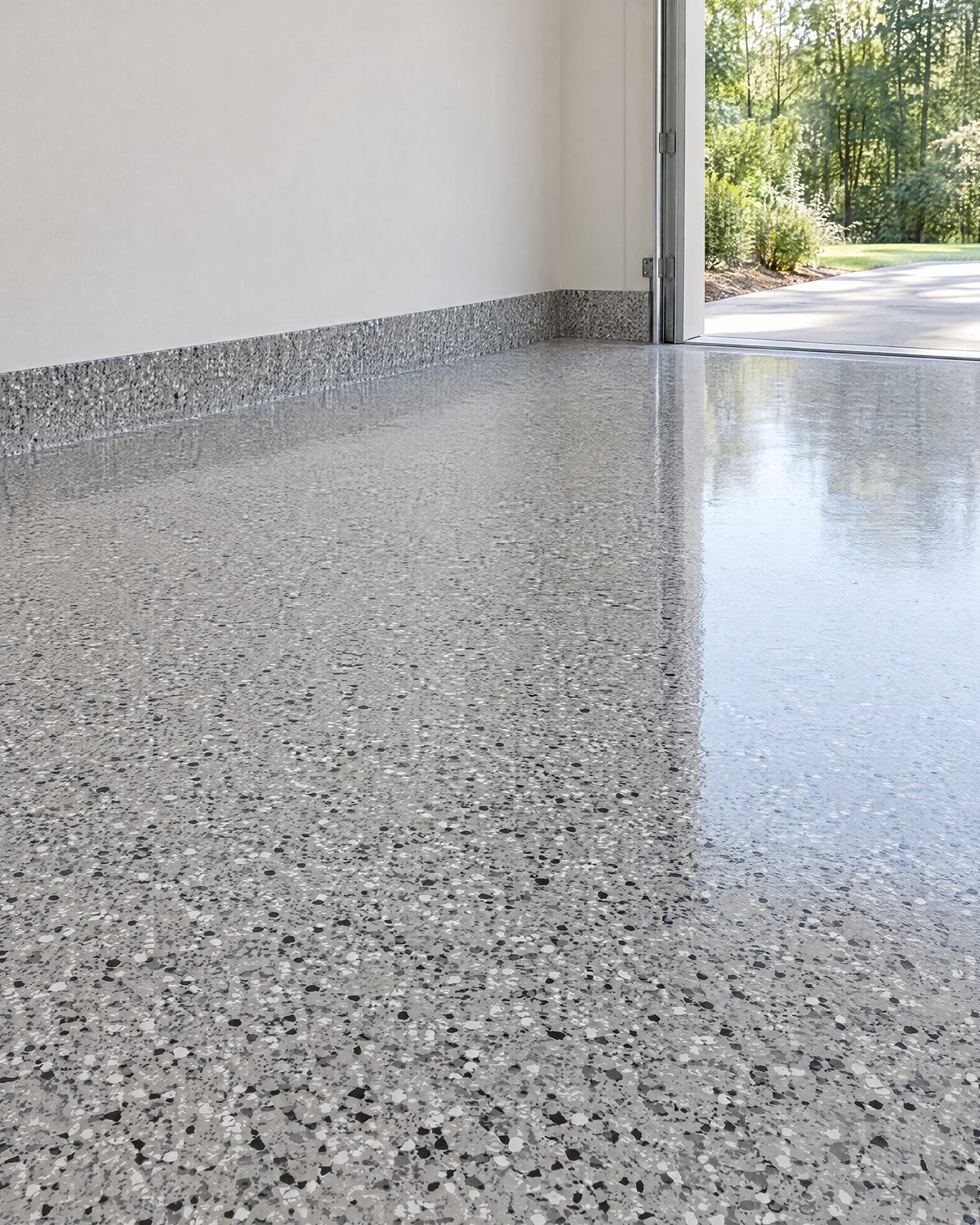
A two-part epoxy base, a full flake broadcast and a clear topcoat for one-, two- and three-car garages: each layer's film thickness from named data sheets, moisture testing and grinding, cure times by temperature and national costs by garage size.
Typical: $1,600 to $5,800 for a 2-car garage, national (HomeGuide, Feb 2026); $4 to $10 per sq ft installed
-
Garage Floor Coating
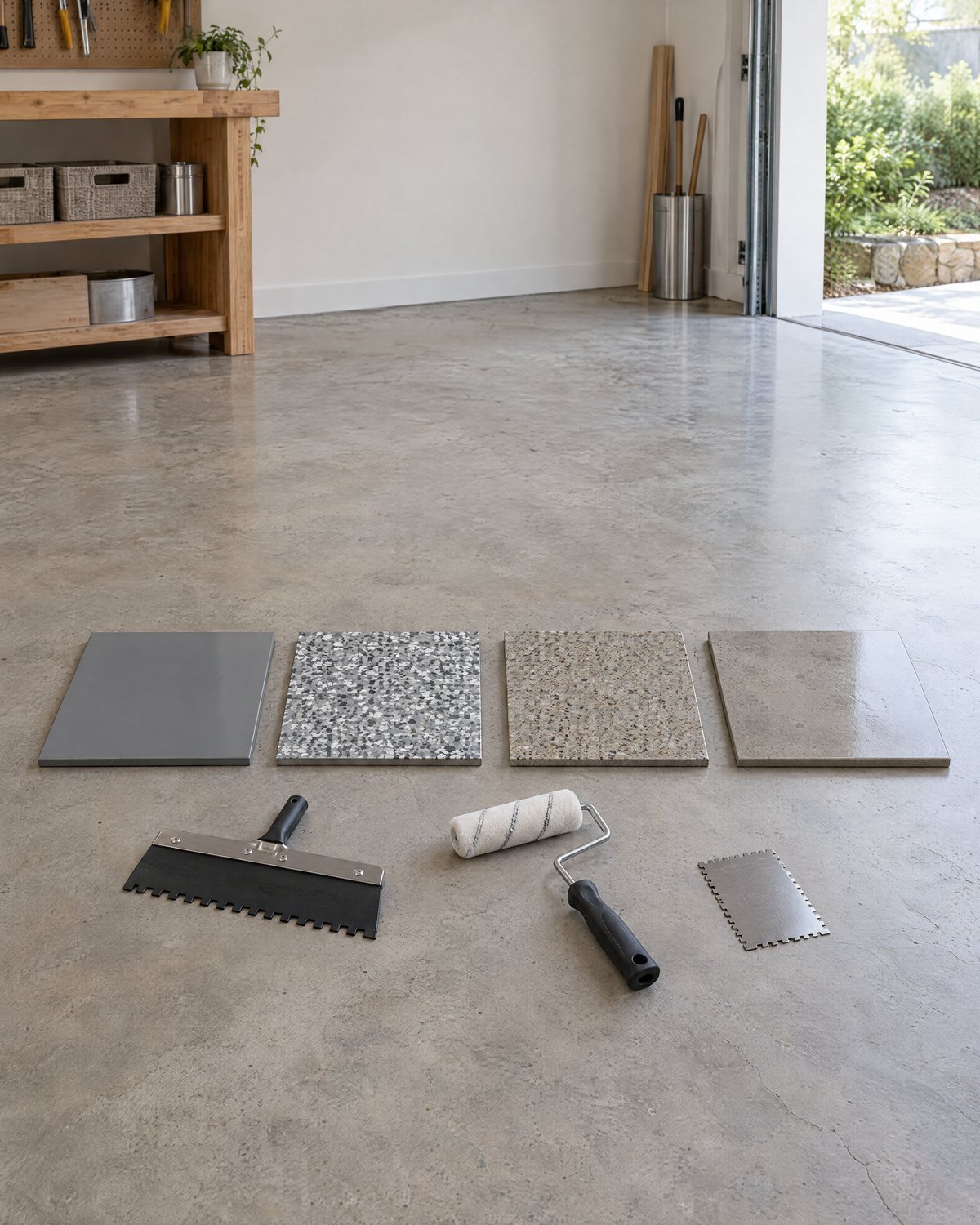
The choice between garage floor coatings, from each maker's own data sheet: two-part epoxy, polyaspartic, polyurea, one-part floor paint and sealers by solids, film thickness and cure time, with hot-tire limits, New York's VOC limit and published national prices.
Typical: $4 to $12 per sq ft coated, $2 to $4 painted, $1 to $3 sealed; national (HomeGuide, Dec 24, 2024)
-
Garage Flooring
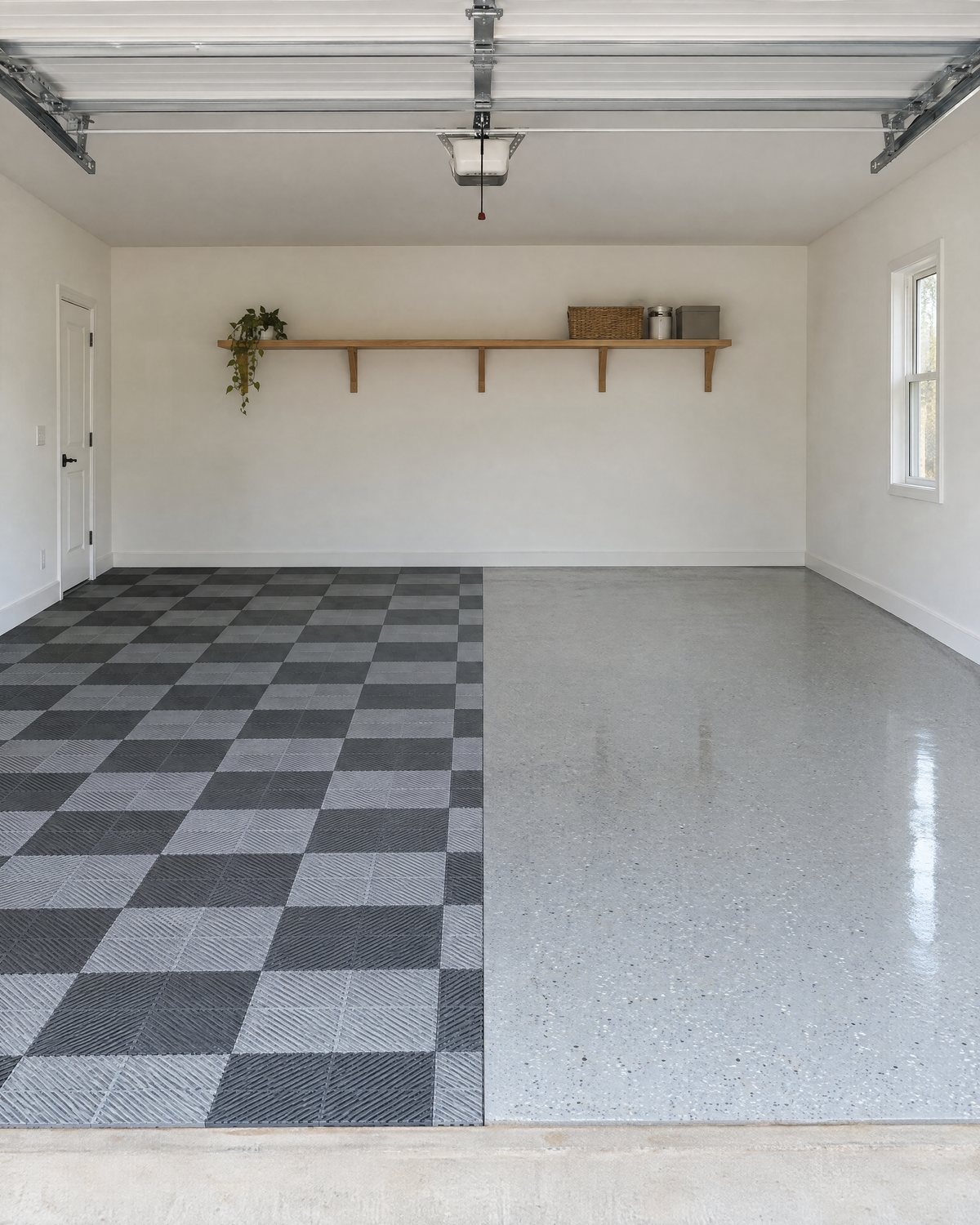
A resin coating, interlocking tiles, a roll-out vinyl mat or sealed bare concrete, side by side: what each is made of, how thick it is, and what its maker prints about moisture, tires, salt and warranty terms, with national survey costs. We install coatings; we do not sell tiles or mats.
Typical: Coating $4 to $12 per sq ft installed; tiles $2 to $5 per sq ft, self-installed; national (HomeGuide, Dec 2024)
-
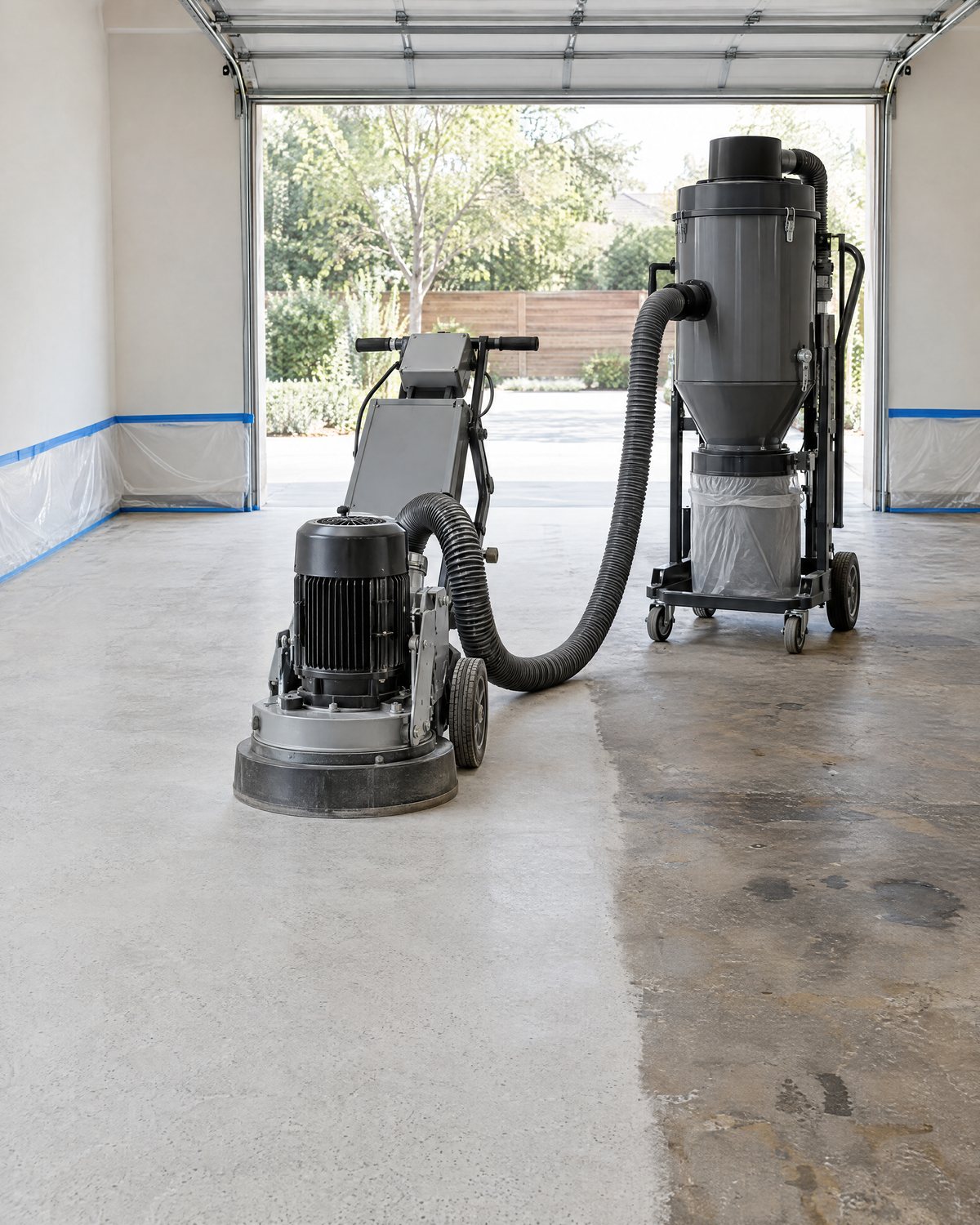
Epoxy Floor Installation
How an epoxy floor goes down: empty the room, test the slab for moisture, grind, repair, prime, coat, broadcast, scrape, topcoat, cure. Pot life, recoat and traffic times come from named data sheets, set beside what a consumer kit's own sheet asks of you.
Typical: $4 to $10 per sq ft installed; premade DIY kits $200 to $700; national (HomeGuide, Feb 2026)
-
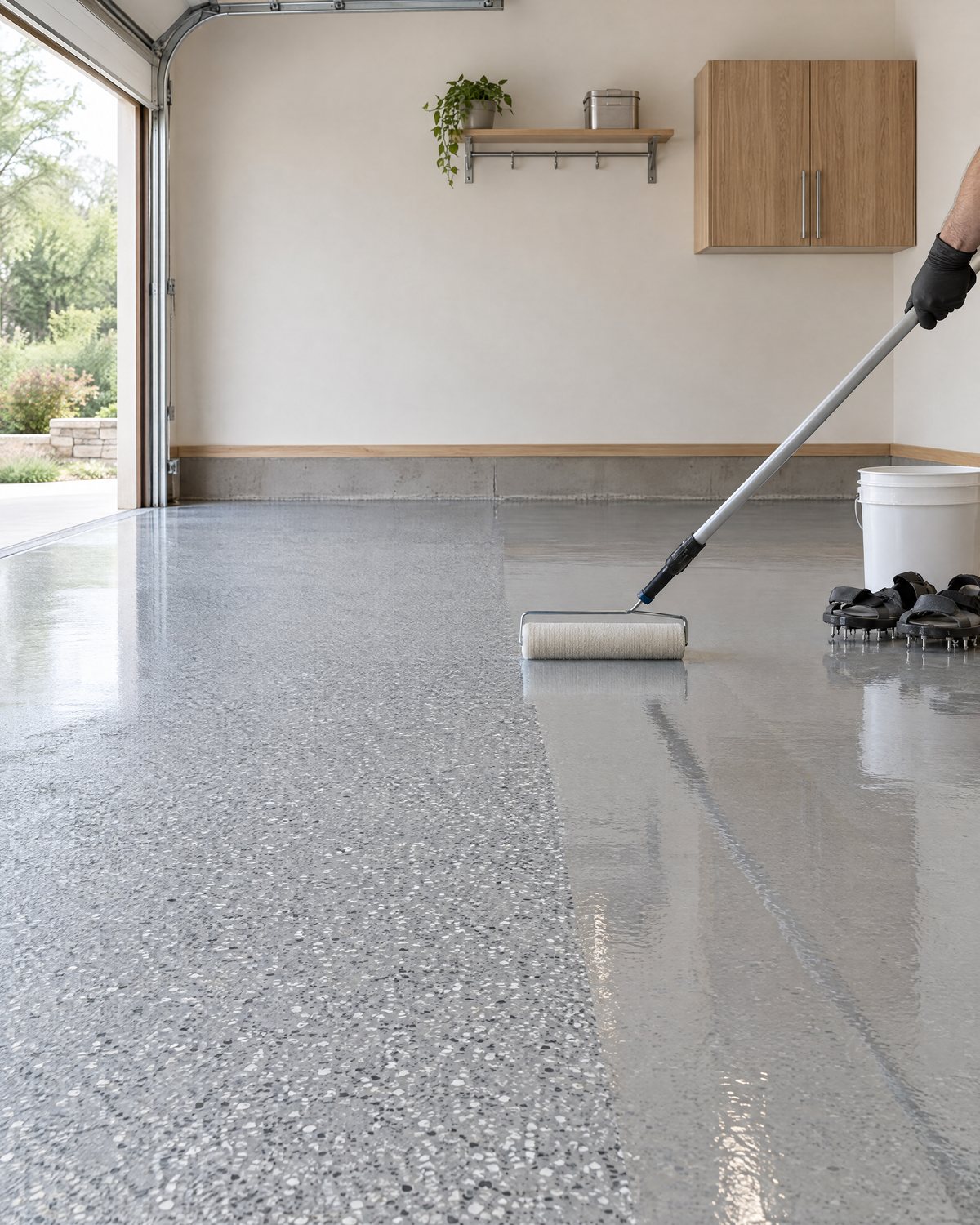
Polyaspartic Floor Coating
Polyaspartic is a fast-curing aliphatic polyurea, used as a clear topcoat over an epoxy or polyurea base or as a full system. We explain cure times, temperature limits and UV stability from named data sheets, beside NOAA's normals for Centerport and national survey prices.
Typical: $5 to $12 per sq ft installed, national (HomeGuide, Nov 2024); polyurea $5 to $10 (HomeGuide, Sept 2025)
-
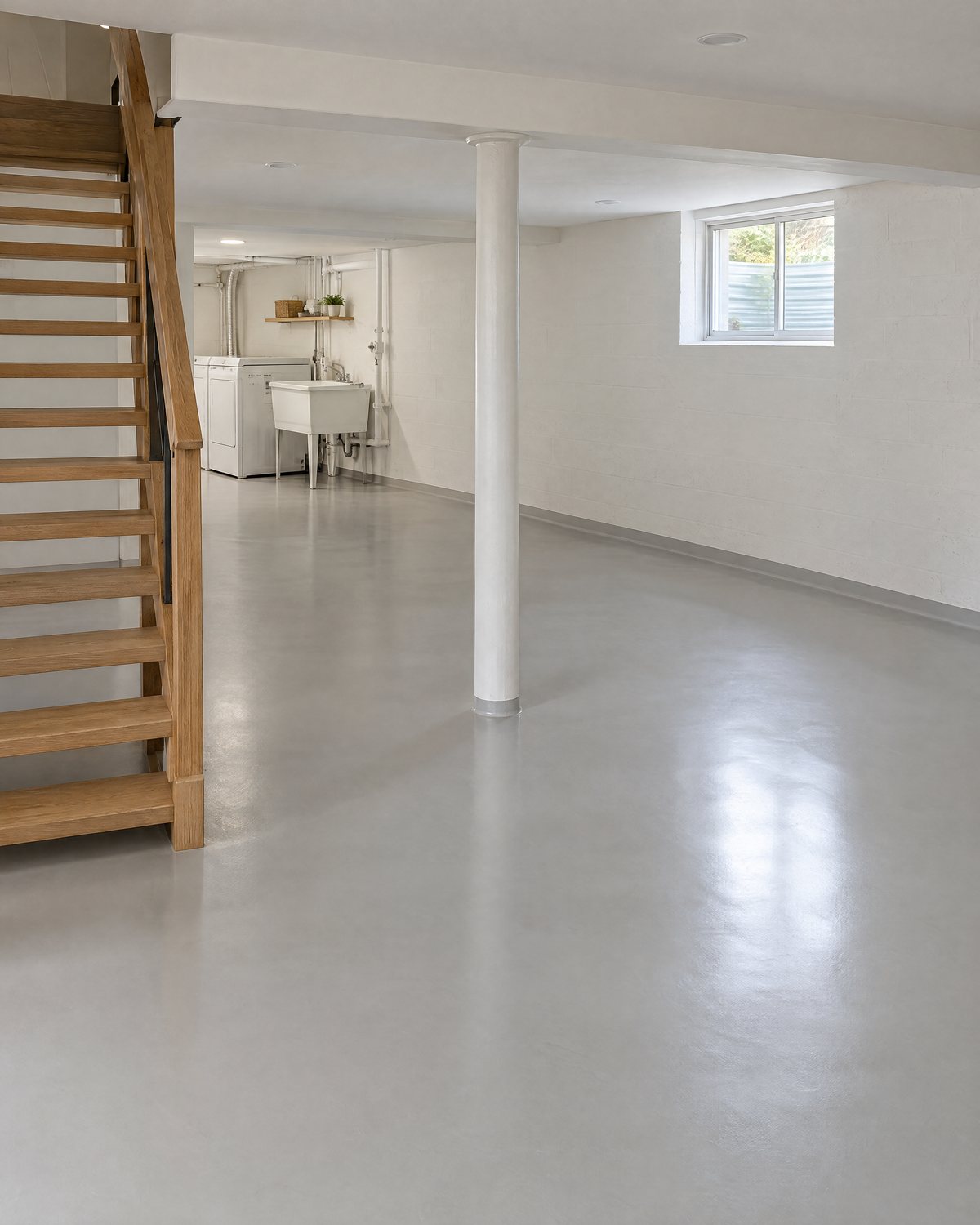
Basement Floor Epoxy
Epoxy on a below-grade slab: the three ASTM moisture tests and the limits data sheets set, what a mitigation primer can and cannot do, mold, radon, permits and national survey costs.
Typical: $1,200 to $20,000 for a 300 to 2,000 sq ft basement, national (HomeGuide, Feb 2026); $4 to $10 per sq ft installed
-
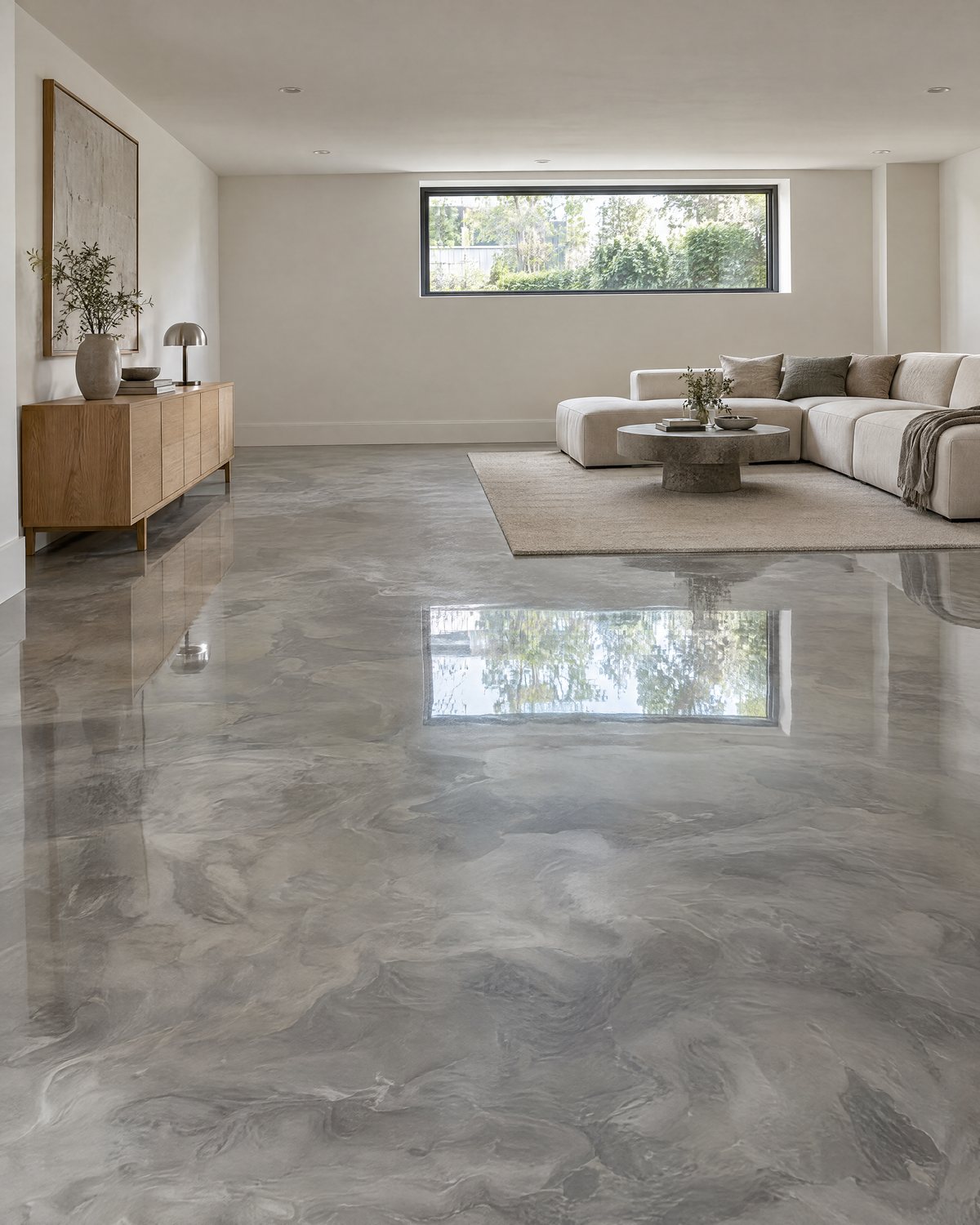
Metallic Epoxy Floors
A clear two-part resin carrying metallic pigment over a pigmented base coat: how the pattern forms, why no two floors match, film thickness and cure times from the makers' sheets, the limits they state, and what the national surveys print.
Typical: $5 to $12 per sq ft in national add-on tables (This Old House, Mar 2026; Bob Vila, Apr 2024, materials only)
-
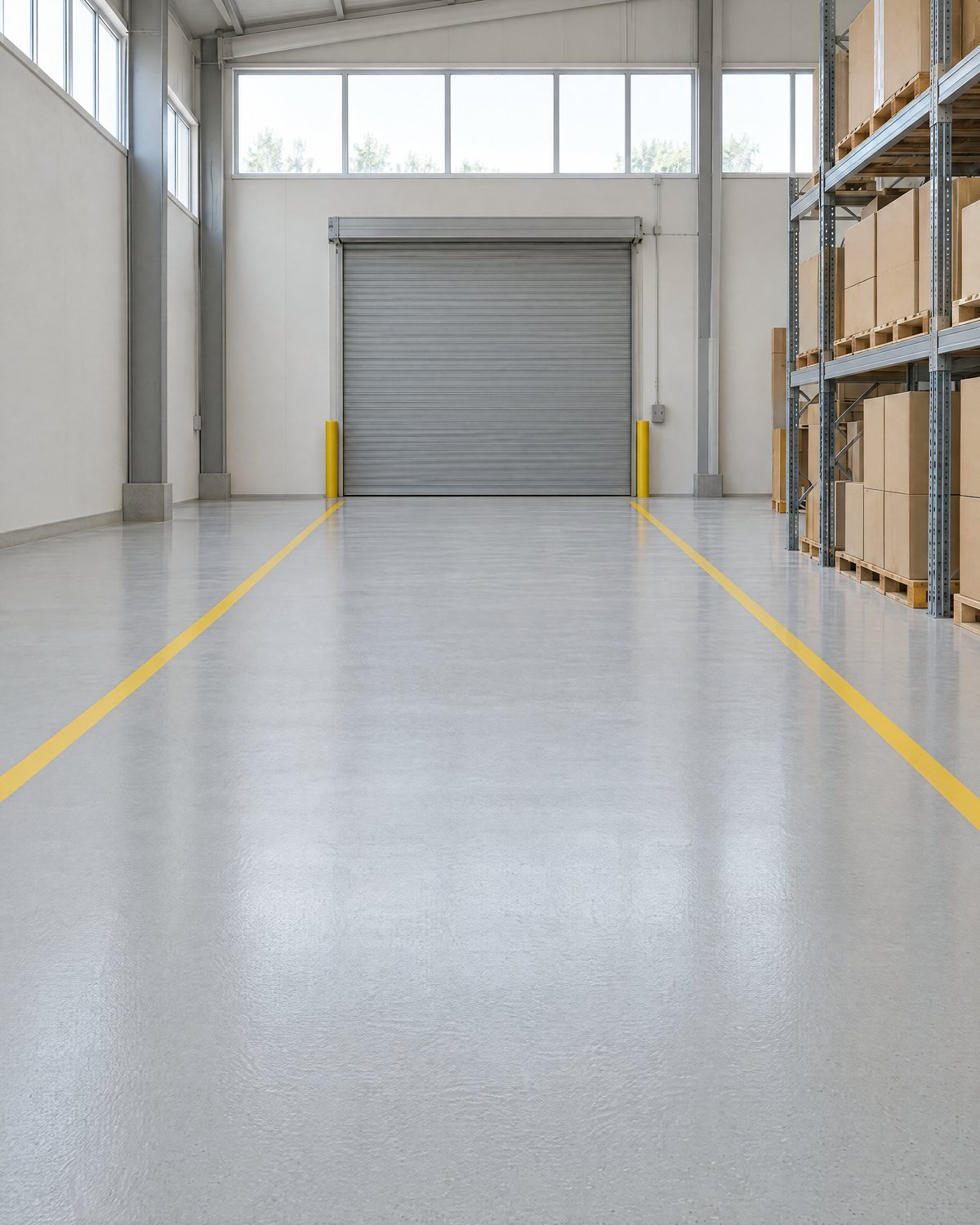
Commercial Epoxy Flooring
Resin floors for warehouses, service bays, commercial kitchens, retail floors and mechanical rooms in the Town of Huntington: system types and thickness, urethane cement, slip test values, OSHA, State and Town rules, and working hours.
Typical: $12 or more per sq ft for a 100% solid coating, national (HomeAdvisor, June 2026): one survey line, not a price table
-
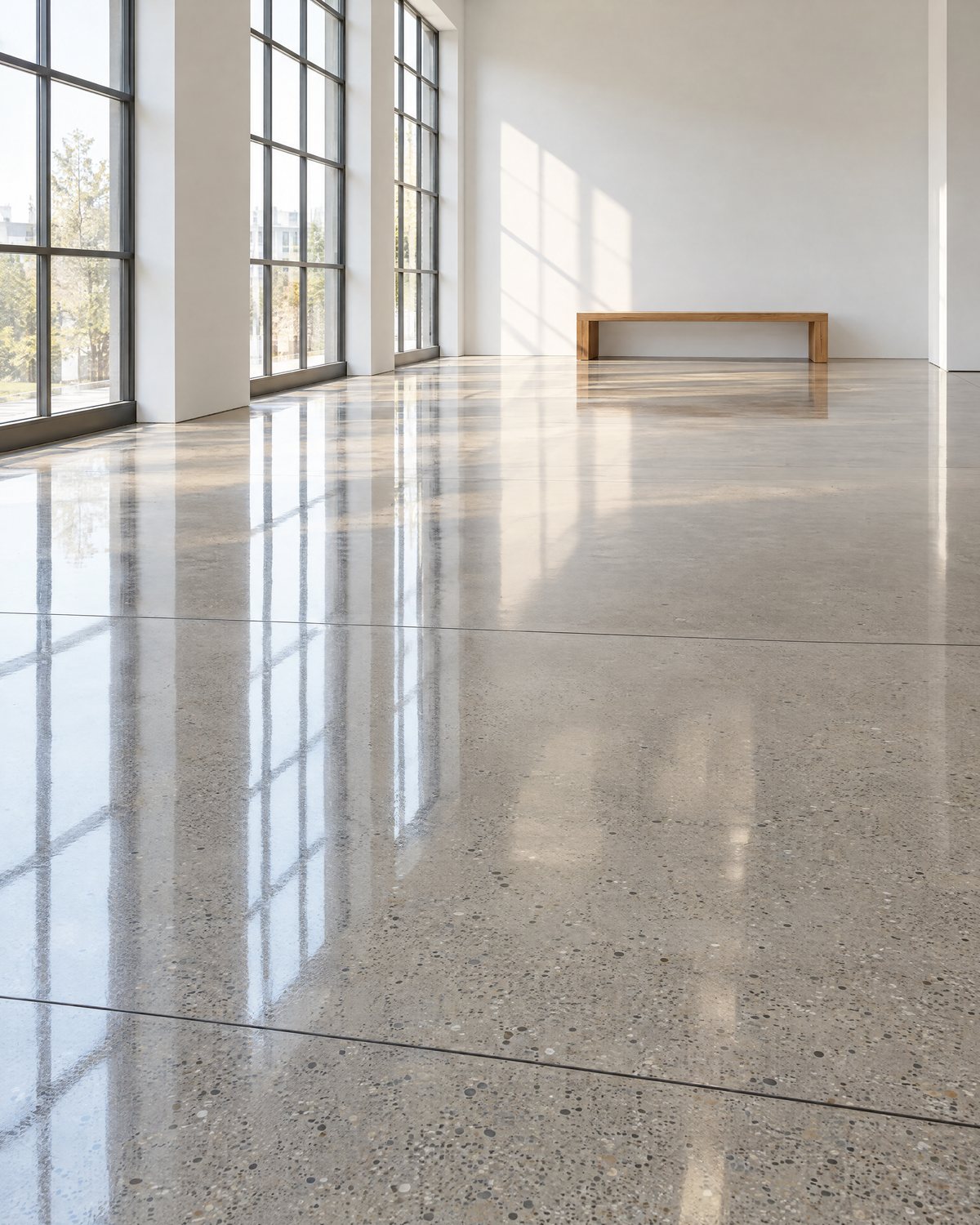
Polished Concrete Floors
Concrete ground, honed and polished until the slab itself carries the gloss: the Concrete Polishing Council's gloss levels and aggregate exposure classes, the grit sequence, densifiers, slip test values, care and national survey costs by level of finish.
Typical: $3 to $12 per sq ft for basic finishes, national (HomeGuide, Feb 2026); $5 to $15+ decorative
-
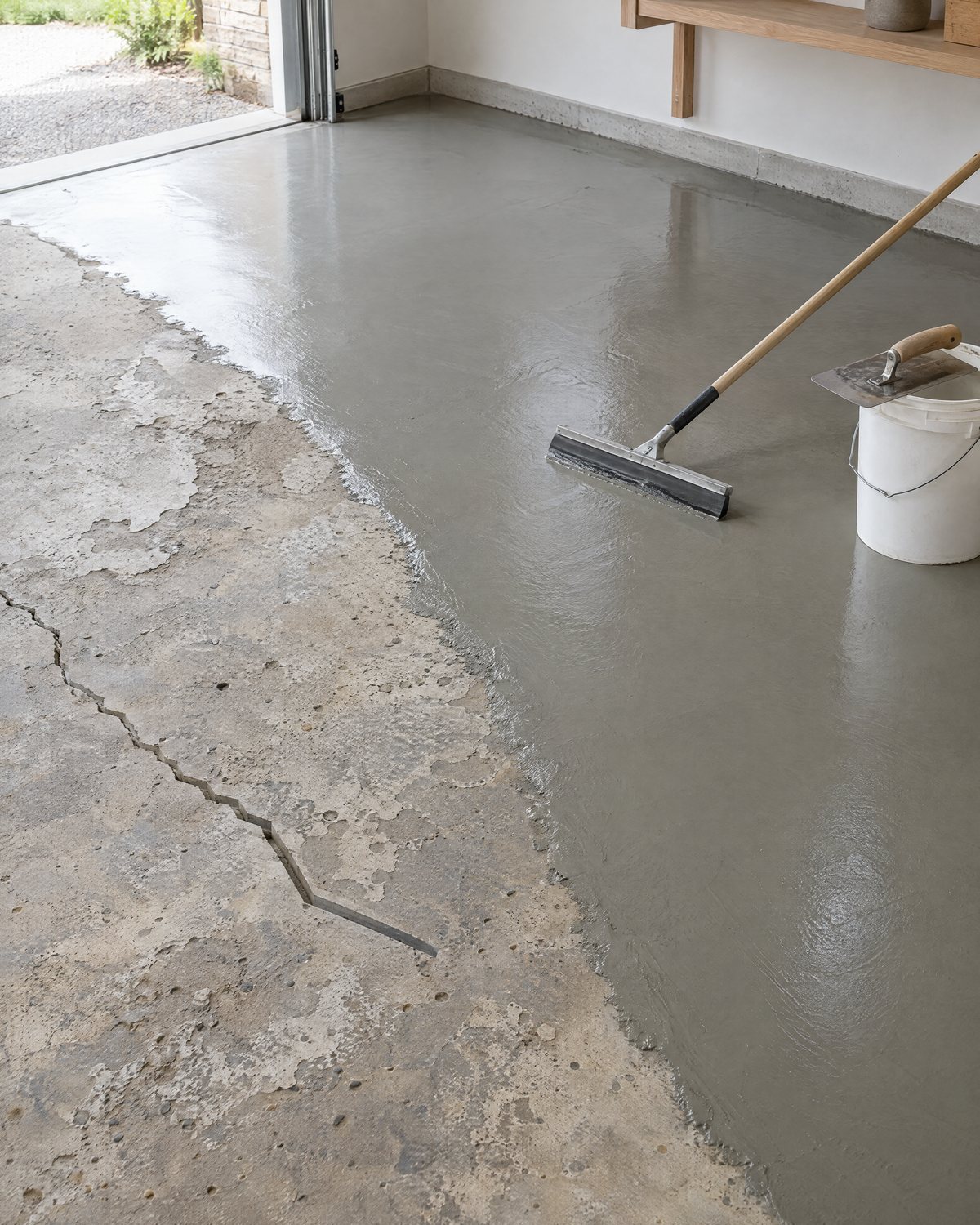
Concrete Resurfacing
Worn, pitted and cracked garage, basement and shop slabs rebuilt before a coating or a polish: resurfacers and self-leveling toppings from named data sheets, crack and joint repair, and national survey costs.
Typical: $3 to $7 per sq ft (HomeGuide, Feb 2026); garage floor repair $500 to $1,750 (Fixr, Jan 2025); both national


In detail
The slab, the system and the cure
-
The Slab
Ground concrete. A slab is weakest at its surface, and Wolverine Coatings' bulletin on preparing concrete states that "a coating's bond strength can never exceed the pull-off strength of the surface to which it is applied". Grinding takes that surface off and leaves a profile: ICRI Guideline 310.2R numbers concrete surface profiles CSP 1 to CSP 10.
-
The System
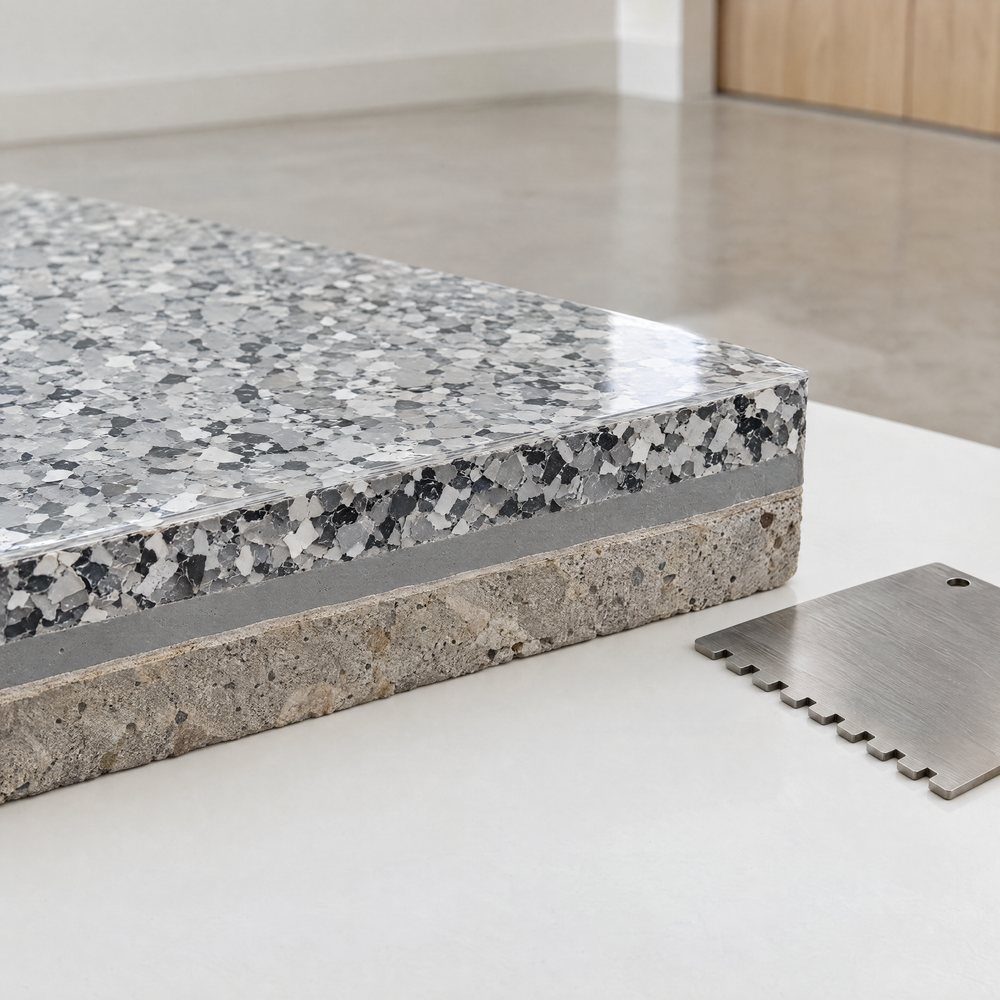
Vinyl flake broadcast into epoxy and finished with a topcoat. Thickness is counted in mils, thousandths of an inch: Sherwin-Williams' article on coating thickness puts the great majority of professional resin floor systems between 20 and 250 mils, and its submittal for the Resuflor Deco Flake II system gives a double flake broadcast a nominal 60 mils.
-
The Cure
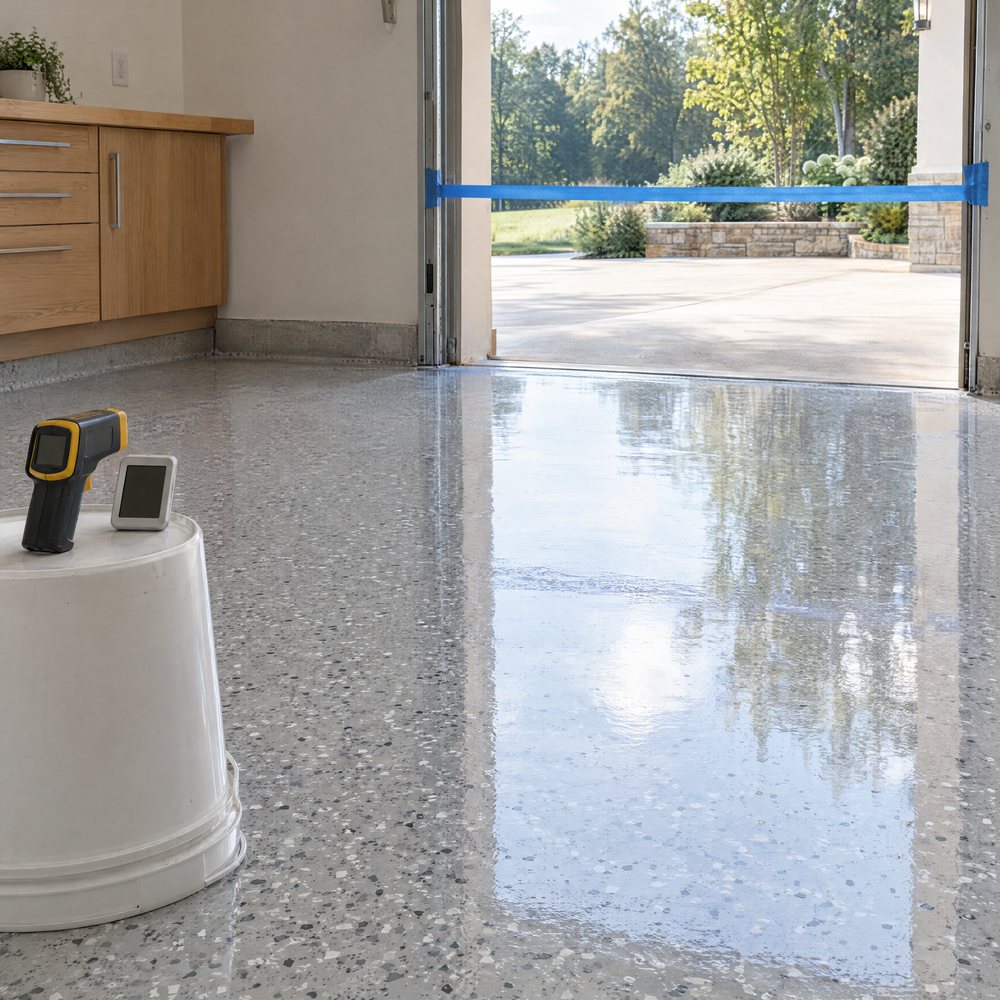
Curing is a chemical reaction, and temperature sets its pace. At 77 degrees F, Sherwin-Williams' data sheet for ArmorSeal 1000 HS, a two-part epoxy, gives a 6.0 mil wet film 24 hours to foot traffic and 7 days to full cure. At 50 degrees F the same sheet gives 48 hours and 10 days.


Four things we do on every floor
-
We test before we choose
We test the slab for moisture before we choose a system, by the test the coating's data sheet names. The limits are the makers': Sherwin-Williams' Form G-1, revised 02/26, allows its resin floors no more than 3 pounds of moisture per 1,000 square feet per 24 hours by ASTM F1869, the calcium chloride test, and 80% relative humidity or lower by ASTM F2170, the probe test.
-
We grind to a profile
We grind with diamond tooling instead of acid etching, to the concrete surface profile (CSP), or roughness, that the system's data sheet calls for. Wolverine Coatings' bulletin states that acid etching "will normally yield a CSP1 profile and is typically only used for very thin coatings"; ICRI's Concrete Repair Bulletin gives CSP 3-5 as the profile in its example of a thicker, high-build coating. Our grinders run with the dust collection OSHA's silica rule (29 CFR 1926.1153, Table 1) names.
-
We schedule by the data sheet
We measure the air temperature, the slab temperature and the dew point before we mix, and the product's data sheet sets the schedule from there. Each figure is one product's, at a stated temperature: Sherwin-Williams' ArmorSeal 1000 HS sheet, revised August 10, 2021, allows the next coat after 8 hours at 77 degrees F and after 24 hours at 50 degrees F, its minimum application temperature, and no later than 7 days.
-
We put it in writing
The contract we sign with you gives the start and completion dates and the cost of labor and materials (Suffolk County Code section 563-21) and names the coating products (New York's General Business Law section 771). Our quote states what is and is not covered and shows any moisture-mitigating primer as its own line. You also receive, in writing, the foot traffic and vehicle traffic times for your floor, from the data sheets of the products on it.
How a job runs
From your description of the floor to the cure times in writing
-
You describe the floor
Tell us the room and its size, how old the slab is and what covers it now: paint, a sealer, an old coating or nothing. Say what you can see: cracks, pitting, damp patches, salt stains at the door, a deposit on the surface. The deposit matters: Euclid Chemical's Technical Bulletin CP-30 says efflorescence occurs when "water migrating through concrete or masonry picks up free salts" and leaves them there.
-
We visit, test and measure
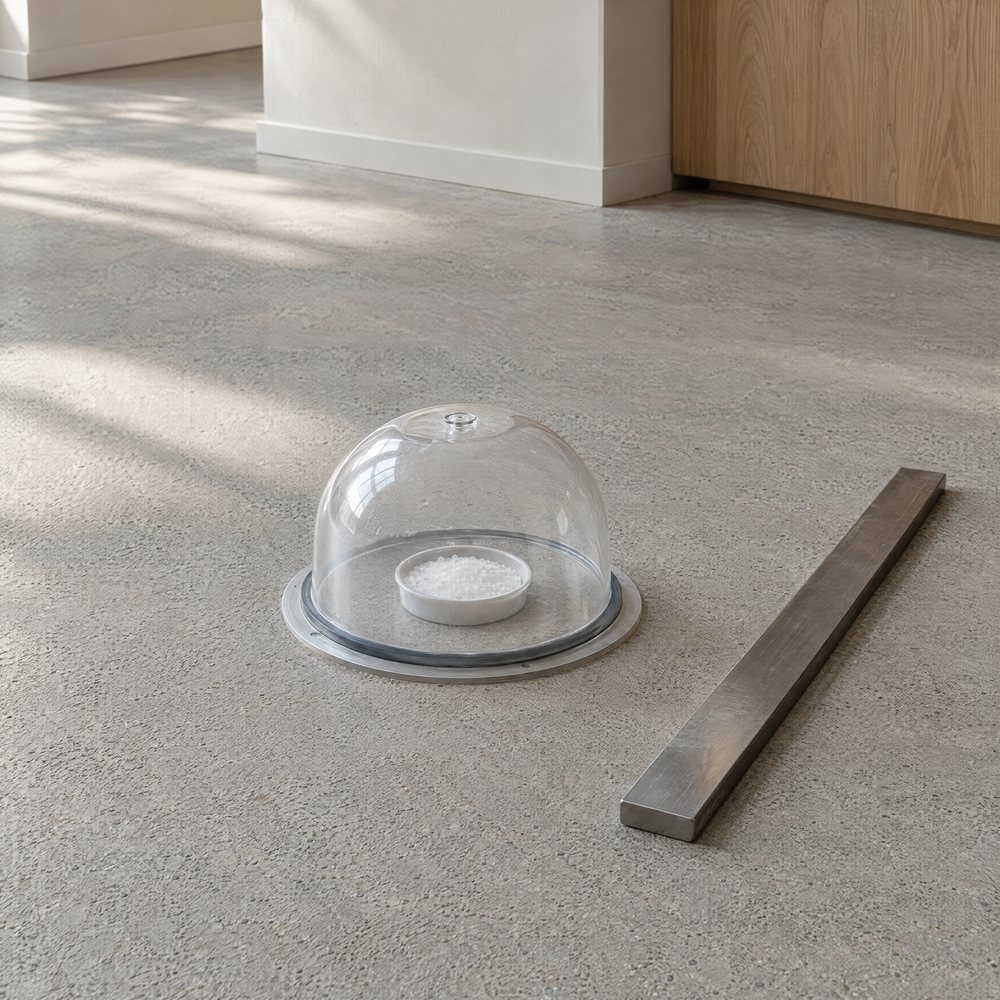
We measure the floor, look at the cracks, and test the slab for moisture by the test the coating's data sheet names. That is ASTM F1869, calcium chloride sealed under a dome on the bare concrete, or ASTM F2170, probes set in test holes at 40% of the slab's thickness where it dries from one side, as Wagner Meters, a probe maker, describes it.
-
We quote in writing
You receive a free written quote that states what is and is not covered and shows any moisture-mitigating primer as its own line. If you go ahead, the contract is written and signed by both of us; on a home improvement contract, New York's General Business Law section 771 requires a notice that you may cancel until midnight of the third business day after the day you sign.
-
We prepare, coat and hand back
We work inside the Town of Huntington's weekday hours for building work, 7:00 a.m. to 6:00 p.m. (Town Code section 141-4). We grind, repair cracks, holes and a scaled surface before the primer, and say which cracks will still show. The coats follow at the intervals their data sheets set. After the last coat, you get the foot traffic and vehicle traffic times in writing.
Huntington, New York
An epoxy floor here starts with the slab, the salt and the season
Most homes in the Town of Huntington are detached houses, and the 1950s and 1960s built more of the Town's housing than any other two decades. The Census Bureau's 2020-2024 American Community Survey estimates that 84.0 percent of the Town's 73,982 housing units are one-unit detached houses, that the median year built is 1963, and that 26.6 percent of the units date from the 1950s and 24.2 percent from the 1960s. Of 71,542 households, 88.7 percent own their homes and 71.3 percent have two or more vehicles available. The survey counts houses and vehicles, not slabs, but age matters under a coating: Sherwin-Williams' technical article on blistering says older slabs "may experience vapor transmission or delamination if not properly sealed or if coatings were applied without moisture testing". Our Huntington floor coating data page gives the same figures hamlet by hamlet.
De-icing salt reaches a garage slab on the cars. The Town's Highway Office, responsible for snow and ice control, works across "almost 800 miles of roads and right-of-ways", and Suffolk County's hazard mitigation plan (August 2020) lists roadways that "could be damaged due to the application of salt and intermittent freezing and warming conditions". NOAA's 1991-2020 normals for Centerport, inside the Town, put the days a year whose minimum temperature is at or below 32 degrees F at 88.1 and those whose maximum is at or below it at 22.4. The Portland Cement Association's IS177 defines scaling as "The general loss of surface mortar exposed to freezing and thawing", and the National Ready Mixed Concrete Association's CIP 2 names "Application of excessive amounts of deicing chemicals" among its causes. We repair a scaled surface before the primer. Our epoxy flooring pros and cons guide sets salt beside the other downsides.
The season changes two numbers a data sheet depends on: temperature and dew point. NOAA's 1991-2020 normals for Centerport give a winter mean of 33.6 degrees F and count days that reach 50 degrees F: 8.6 in December, 4.5 in January and 5.0 in February. Westcoat's specification sheet for its EC-36 epoxy sets 50 degrees F as its lowest application temperature, and Citadel's technical data CDL-11 requires a surface at least 5 degrees F above the dew point under its Polyurea-350 base coat. At 7 a.m. standard time in mid-month, NOAA's 2006-2020 hourly normals for Farmingdale Airport, in the Town of Babylon, leave a calculated gap of 6.3 degrees F (mid-October) to 10.5 degrees F (mid-April) between air temperature and dew point; at 2 p.m. it is 14.1 to 20.4 degrees F. These are outdoor air figures, not slab or garage readings, so we measure the room before we mix.
Below grade, the question is water. The Town has five harbors on its north shore, and Town Code Chapter 168 adopts the Federal Emergency Management Agency's flood maps effective September 25, 2009. Suffolk County's hazard mitigation plan (Section 5.4.15, August 2020) defines shallow groundwater flooding as a water table "either cyclically or persistently above the level of subsurface structures", with "groundwater seepage into basements" among its effects, and places it in low-lying areas along the coast, near surface water and "along ancestral drainage courses". Its table puts none of the Town of Huntington's population in the mapped hazard area, and the plan's Town section (October 2020) ranks shallow groundwater "Low" and flood "High". A map is not a reading of your slab: University of Minnesota Extension writes that vapor "can diffuse from the wetter ground through concrete walls and floors". So a basement slab is tested before it is coated.
Suffolk County licenses the contractor, and County and State law both say what the contract must hold. County Code section 563-17 makes it unlawful to do business as a home improvement contractor without a County license and requires the license number in all advertising for home improvement contracting; section 563-16 defines that work as the repair, remodeling, alteration or improvement of one- or two-family houses, and names flooring. Ask any contractor for the number. Section 563-21 requires a written contract that "specifies starting and completion dates, description of costs of labor and materials". New York's General Business Law section 771 requires the contract to be signed by all the parties and to describe the work and the materials, "including make, model number or any other identifying information"; section 770 applies it where the price exceeds five hundred dollars.
The Town of Huntington decides permits and working hours in its hamlets. Its Building and Housing guideline, revised 9/1/2021, reads: "NO BUILDING PERMIT REQUIRED for Roofing, Siding and Window/Door (if replacing in-kind and no structural changes) driveways, slabs, hot tubs and Antennas for home TV. Please contact the Building Department before working on structures." The same guideline requires plans for finished basements and converted garages. Under Town Code section 141-4, the alteration or repair of a building is a noise disturbance outside the hours of 7:00 a.m. to 6:00 p.m. on weekdays, and weekdays exclude Saturdays, Sundays and legal holidays. Four incorporated villages, Huntington Bay, Lloyd Harbor, Northport and Asharoken, have their own codes and issue their own building permits; the Village of Huntington Bay's code bars building work before 8:00 a.m., after 5:00 p.m. and on Saturdays, Sundays and public holidays.
Published prices
National survey ranges, each with its source and date
The published epoxy flooring cost is $4 to $10 per square foot installed in HomeGuide's national survey dated February 3, 2026, and $2 to $12 per square foot in Angi's national data of August 2026; no price survey publishes a figure for Huntington, Suffolk County or Long Island. This page sets the published ranges side by side, each with its survey and its date. They are national figures from price surveys: none is a Huntington price and none is our price. Where a survey prints a "New York, NY" row, that row is New York City, and we call it that. The surveys disagree, so we attribute each figure and do not average them. The table opens with the rate per square foot and three garage sizes; our garage floor epoxy page describes the system behind them. For a price for your own floor, we visit, measure and test the slab, then send a free written quote.
| What is priced | Published national range |
|---|---|
| Epoxy flooring, installed, per square foot (HomeGuide, February 2026) | $4 to $10 per sq ft, national |
| Epoxy floor, one-car garage of 288 to 392 sq ft (HomeGuide, February 2026) | $1,200 to $3,900 installed, national |
| Epoxy floor, two-car garage of 400 to 576 sq ft (HomeGuide, February 2026) | $1,600 to $5,800 installed, national |
| Epoxy floor, three-car garage of 576 to 864 sq ft (HomeGuide, February 2026) | $2,300 to $8,600 installed, national |
Questions
What owners ask about cost, moisture, winter work and permits
How much does it cost to install epoxy flooring?
Installed epoxy flooring costs between $2 and $12 per square foot on three national price surveys. HomeGuide's page dated February 3, 2026, prints $4 to $10; Angi's August 2026 data, $2 to $12; This Old House's March 2026 page, $3 to $12 for a hired job. By whole project, HomeAdvisor's national June 2026 page puts the normal range at $1,650 to $3,494 and the average at $2,526. No survey publishes a price for epoxy flooring on Long Island, in Suffolk County or in Huntington, and none of these figures is ours. We price a floor after we have measured and tested it, in a free written quote.
Is it expensive to epoxy your floor?
An epoxy floor is priced above carpet and below tile and hardwood on the published national figures, and above painting or sealing the same slab. HomeGuide's flooring installation page, dated February 5, 2026, prints epoxy at $4 to $10 per square foot installed, against $2 to $8 for carpet, $10 to $50 for tile and $11 to $25 for hardwood. Angi's August 2026 data prints $1.50 to $3 per square foot for concrete painting, and HomeGuide's epoxy page of February 2026 prints $1.00 to $2.00 for sealing with acrylic, which it says needs reapplying every 2 to 3 years. Where damage is widespread, the same HomeGuide page adds resurfacing at $3 to $7 per square foot. All are national figures; no survey prices Long Island.
How long will epoxy last on a floor?
No independent source we have found gives the life of an epoxy floor in years, so we do not state one. For epoxy, the makers we cite give no number. Stonhard, a resin floor maker, writes: "The key to long-lasting floors is to buy the correct floor for your space and ensure that it is properly used and cleaned." Sherwin-Williams' flake system submittal says "years of service with minimal maintenance". Price surveys do print years: HomeGuide's February 2026 page says 3 to 5 years for water-based epoxy or 10 to 20 years for solid epoxy, which is that survey's statement. What shortens a floor's life, in Stonhard's account, is heavy traffic, chemical attack, grit worn over the surface and rough brushes or pads; recoating "as needed" protects the base system.
Does my concrete need a moisture test before epoxy?
Yes: every slab we coat is tested for moisture first, because moisture that cannot pass through a coating collects beneath it; KTA-Tator, a coatings inspection firm, writes that trapped water "can cause the coating to blister and disbond". ASTM F1869, the calcium chloride test, measures the vapor leaving the surface; ASTM F2170 reads relative humidity from probes set in the slab; ASTM D4263, the plastic sheet method, shows only whether moisture is present. The limit is each product's own: under ASTM F2170, Sherwin-Williams' Form G-1 accepts 80% or lower, Simiron's Polyaspartic HS data sheet 75% and Sika's Sikafloor-264 data sheet 85%. Over the limit, a moisture-mitigating primer goes on our quote as its own line; our basement floor epoxy page gives the limits the primer makers state.
Can an epoxy floor be installed in winter in Huntington?
Yes, an epoxy floor can be installed in winter when air, slab and dew point are inside the product's data sheet limits. The sheets differ by chemistry, as our polyaspartic floor coating page sets out: Sika's data sheet for its Sikafloor-264 epoxy sets an ambient minimum of 50 degrees F; Laticrete's for its Spartacote Flex Pure polyaspartic lists low temperature cure at 25 degrees F as a feature, not a limit. NOAA's 1991-2020 normals for Centerport give January a normal high of 37.9 degrees F. That is outdoor air, not a slab or garage reading; we take our own readings before we mix. Cold also slows the cure: the Sika sheet gives light traffic at about 2 days at 68 degrees F and about 3 days at 50 degrees F.
How soon can I park on a new epoxy floor?
A car can go back after 24 hours on some systems and after several days on others; the product and the temperature decide. Laticrete's data sheet for Spartacote Flex Pure, a polyaspartic, gives vehicle traffic at 24 hours at 70 degrees F and 50% relative humidity. Sherwin-Williams' sheet for ArmorSeal 1000 HS, a two-part epoxy, gives heavy traffic at 48 to 72 hours at 77 degrees F and at 4 to 5 days at 50 degrees F. HomeGuide's February 2026 survey says not to drive on a new epoxy floor for 2 to 7 days. We give you the times for your own floor in writing, from the data sheets of the products on it. Our garage floor epoxy page sets a cure schedule beside Centerport's temperatures.
What should I do before the crew arrives?
Empty the floor, tell us how old the slab is, and keep fuel-burning heaters out of the room. Everything on the slab comes out before we start; Angi's August 2026 data, a national survey, prints at least $100 for moving services or short-term storage. A new slab has to wait: Sherwin-Williams' Form G-1 calls 28 days "the industry standard for curing concrete" and adds that this "is not always sufficient time to allow excess moisture to leave a concrete slab". The same maker's article on amine blush does not recommend fuel-burning heaters such as salamander or torpedo heaters, because they add moisture and carbon dioxide to the air. Our epoxy floor installation page walks the job in order.
Do you coat basements and shop floors as well as garages?
Yes: we coat garage floors, basement floors and commercial floors, and the first question differs in each. In a garage it is salt, tires and temperature. In a basement it is moisture from the ground: Sika's knowledge base calls moisture vapor emission "a natural constituent of any concrete slab", so the slab is tested first, and the Town of Huntington requires a permit for a finished basement. In a shop or warehouse it is load and working hours: Sherwin-Williams' article on selecting a floor system reserves mortar systems for "the greatest chemical resistance, thermal shock resistance, and heavy-duty traffic", and Town Code section 141-4 allows Saturday building work only by permit. Our commercial epoxy flooring page covers the thicker systems.
Do I need a permit to coat a garage or basement floor in Huntington?
Ask the Town's Building Department: no Town of Huntington page we have read says whether coating an existing floor needs a building permit. The Town's Building and Housing guideline, revised 9/1/2021, says no building permit is required for "driveways, slabs" and tells owners to contact the Building Department before working on structures; the office is Room 115 at Town Hall, 100 Main Street. Work around the coating can need a permit: the Town's 311 article "Projects Requiring Permits" lists "Finished Basement" for houses and "Interior Alterations" for commercial buildings. Inside Huntington Bay, Lloyd Harbor, Northport and Asharoken, the village issues building permits.
What license should epoxy flooring contractors have in Huntington?
A Suffolk County home improvement license is the one to ask about. County Code section 563-17 makes it unlawful to do business as a home improvement contractor without one, and section 563-16 names flooring in its definition of that work on one- or two-family houses. The number must appear in the contractor's advertising, so ask for it with every quote; the County's Consumer Affairs office in Hauppauge verifies licenses by phone. No County page we have read mentions floor coatings by name, so that office is also where to confirm how a job is classed. New York's General Business Law section 771 requires the contractor's license number, if applicable, in the written contract.
Where we work
Huntington and the hamlets and villages of the Town

- Huntington
- Huntington Station
- South Huntington
- West Hills
- Halesite
- Huntington Bay
- Lloyd Harbor
- Cold Spring Harbor
- Centerport
- Greenlawn
- Elwood
- East Northport
- Dix Hills
- Melville
Tell us about the floor for a free written quote
Give us the room, its size and what is on the slab now. We visit, measure and test it, then send the quote in writing.