Service area
Epoxy Flooring for Cold Spring Harbor Garages, Basements and Shops
Garage, basement and shop floors in Cold Spring Harbor, a Town of Huntington hamlet of older houses with a historic Main Street.
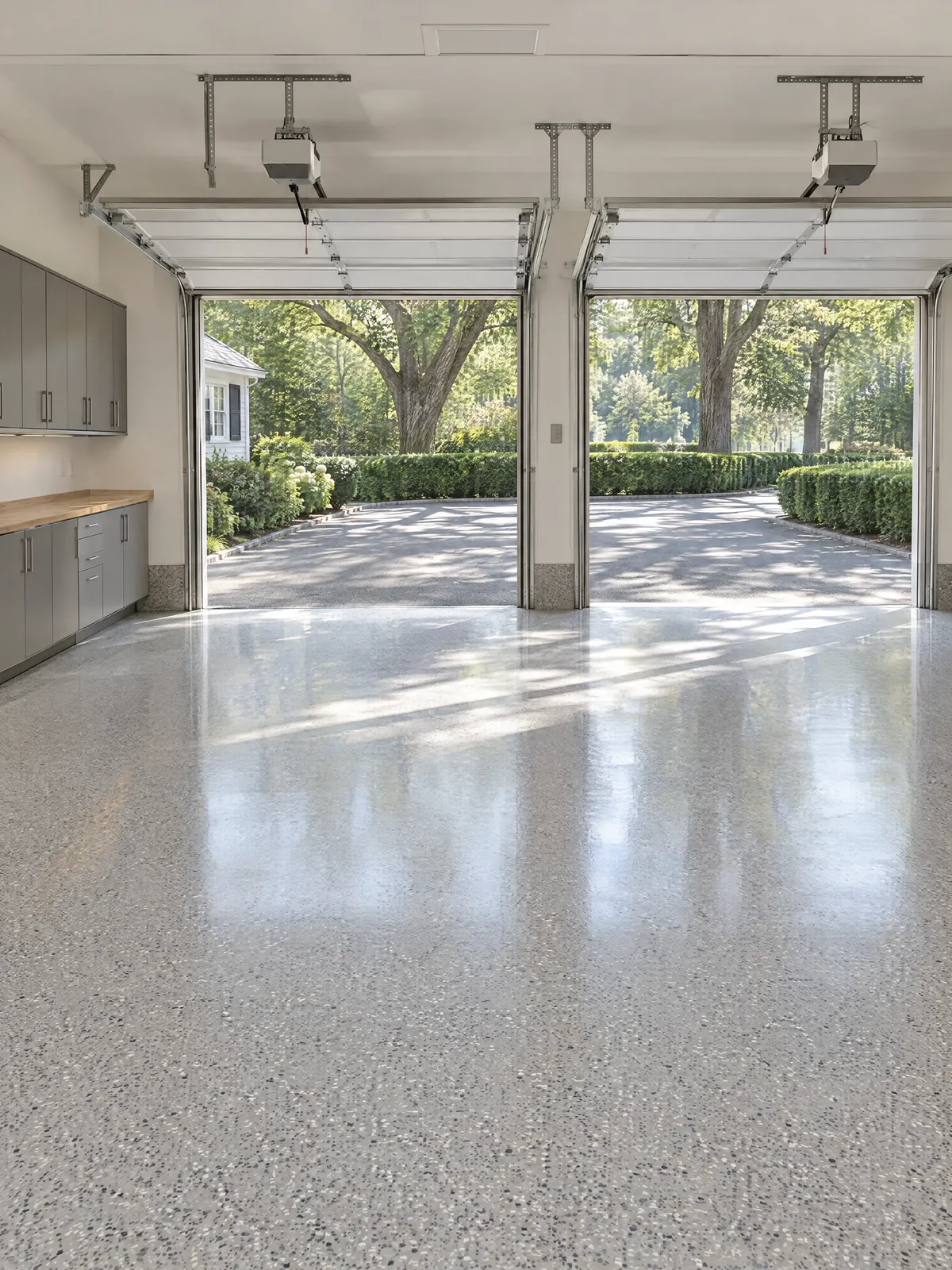
The National Register nomination for the Huntington Multiple Resource Area, entered in 1985, speaks of "the unincorporated village of Cold Spring Harbor", and the phrase still fits: a harbor, a Main Street that doubles as Route 25A, and no village government, so the Town of Huntington's rules apply. The Census Bureau maps the hamlet as a census designated place, with edges set for statistics, not law, and in its American Community Survey estimates for 2020-2024, one-unit detached houses make up 91.6 percent of the housing units, whose median year built is 1960, plus or minus 5 years.
Age is what matters under a coating. The same survey places 30.5 percent of the hamlet's housing units in its oldest column, built in 1939 or earlier, where the Town as a whole has 10.8 percent, and nothing on the surface of a slab that old says what was laid under it. The floors run from garages and cellars to the back rooms of Main Street, where the Town has designated a historic district.
A single floor's answer comes from the floor itself: we visit, take the moisture reading its coating's data sheet asks for and send a written quote. National survey ranges, each dated, are in our cost guide.
Describe the floor, its size, roughly when your Cold Spring Harbor house went up and what covers the slab now; after a visit and a slab test, the quote comes in writing.
Town permits, a historic district and flood listings in Cold Spring Harbor
With no village government, Cold Spring Harbor takes its building permits from the Town: by the Town's own page, Building & Housing, a division of Engineering Services, issues them from Room 115 at Town Hall in Huntington. The division's filing guide, revised 9/1/2021, lists "driveways, slabs, hot tubs" as work needing no building permit and tells anyone unsure to ask; none of the Town's pages we have read settles whether a coating on an existing floor needs one, so we raise it with the office before work starts.
The Town's own Cold Spring Harbor Historic District covers properties along Harbor Road, Shore Road, Main Street and Goose Hill Road, the Preservation Commission's 2018 guide to historic preservation says, and it dates most buildings in the Main Street district to 1855 through 1890. Town Code section 198-42 designates the district by tax parcel, part of it measured 150 feet in depth parallel to the east line of Harbor Road, New York State Route 25A. Exterior changes in the district wait on a certificate of approval, but under Town Code section 198-41 the article is not written to block interior changes to a landmark, and the guide keeps interior alteration permits outside the Commission's review.
The County's FEMA-approved 2020 hazard plan says the feeder routes to Lloyd Harbor are prone to being cut off by storm flooding and damage, and the Town's chapter of the County's 2026 draft plan names Bulkhead Shore Road, Cold Spring Harbor, in its action to protect that access, still proposed and not started. The same draft's table of the Town's flood-prone areas names no place in the hamlet. Shore Rd appears as flood-prone in the draft's chapter for the Village of Lloyd Harbor, but as a Village-owned road, so the listing covers the Village's stretch, not necessarily the hamlet's. The draft's Town chapter adds that a permit flagged for a flood zone goes to the floodplain administrator.
Garage epoxy in Cold Spring Harbor starts with what lies under an old slab
No garage slab shows its underside, and few houses in Cold Spring Harbor are new: the Census Bureau's 2020-2024 estimate dates just 4.9 percent of the hamlet's housing units to 2000 or later. The 2018 International Residential Code, from which New York drew its 2020 residential code, exempts garages from its vapor retarder rule, a model-code exception we cannot confirm in New York's own text. So before the flake system is settled, we run the moisture test its base coat's data sheet names, and a high reading adds a moisture-mitigating primer, priced on its own line.
At the door, the concrete the tires cross first takes the frost and the meltwater off salted roads. A flaking strip there is cut back to sound concrete and rebuilt before the primer, since Wolverine Coatings' bulletin caps a coating's bond at the pull-off strength of the surface beneath. A full flake broadcast then leaves the texture Torginol's flake data sheet credits with anti-slip qualities, useful where cars come in wet.

Old paint, sealers and warm tires decide the coating in a Cold Spring Harbor garage
A garage at a Cold Spring Harbor house of some age may already hold a layer or two: floor paint, a sealer, a kit coating lifting where the tires stand. Sherwin-Williams counts previously coated floors, and concrete treated with sealers or hardeners, among those needing special preparation before epoxy, so we grind such films off with diamond tooling instead of coating over them, and the quote names that method.
Tires then sort the chemistries. The Census Bureau's estimate for 2020-2024 finds two or more vehicles at 73.6 percent of the hamlet's households, and Euclid Chemical's bulletin CP-22 puts most tire discoloration on acrylic cure-and-seal products while calling epoxy and urethane coatings less likely to tire mark. On Rust-Oleum's ROC-109 sheet, the resin of its one-part "epoxy" floor paint is a "Modified Acrylic Polymer", so for parked cars we quote a two-part system.

When tiles, a mat or bare concrete suit a Cold Spring Harbor garage better
Some Cold Spring Harbor garages are better off without a coating, and we say so though we sell no tiles or mats. An old slab that reads over a coating's moisture limit can still take interlocking tiles: RaceDeck describes its seams as "tight but not watertight" and channels its tiles "to allow air and moisture to escape". A roll-out vinyl mat lies on the floor with nothing fixed to the concrete, which suits an owner not ready to repair the slab.
Tenure counts too: the Census Bureau puts 93.5 percent of the hamlet's occupied housing units in owners' hands for 2020-2024, and a coating is sold with the house, while Swisstrax presents its tiles as something to take to the next one. Bare concrete can take a breathable silane or siloxane sealer, which NRMCA's CIP 2 recommends against scaling, though Prosoco's sheet says its Siloxane PD repellent cannot keep water from getting into cracks and open joints.

Installing in Cold Spring Harbor: Town Code hours, the slab test, a clean harbor
Cold Spring Harbor has no village code, so the Town Code sets the working day: section 141-4 limits building alteration to weekdays from 7 in the morning to 6 in the evening, with Saturday work only by permit, and our grinders keep to those hours. The slab test starts days earlier: where a data sheet names ASTM F1869, a calcium chloride dome sealed on bare concrete stays down 60 to 72 hours by KTA-Tator's account.
The harbor shapes the cleanup. New York's Department of State designated the Oyster Bay and Cold Spring Harbor waters a Significant Coastal Fish and Wildlife Habitat on March 15, 1987, and the Town's stormwater plan, whose spring sweep of winter sand and salt starts near the north shore to protect water bodies, lists paint poured into a drain among illicit discharges. Our grinders use dust collection, one of the two controls OSHA's silica rule gives floor grinders, rather than a water feed, so no slurry is left to wash away, and Town Code section 133-1 sends the job's waste off with us.

Polyaspartic when Cold Spring Harbor cars cannot wait out an epoxy cure
Of Cold Spring Harbor households, 36.8 percent have three or more vehicles available, the Census Bureau estimates for 2020-2024, so each day a garage stays shut puts cars on the driveway. A polyaspartic shortens the wait: Laticrete's Spartacote Flex Pure sheet puts vehicles back on in 24 hours (at 70 degrees F, relative humidity 50 percent), where Sherwin-Williams' ArmorSeal 1000 HS epoxy sheet asks 48 to 72 hours before heavy traffic even at 77 degrees F.
RG-80X, the polyaspartic topcoat in Citadel's technical data CDL-10, may be applied from 30 to 90 degrees F, where the ArmorSeal sheet's minimum is 50 degrees F, and a normal January at NOAA's Centerport station has 4.5 days that reach 50 degrees F outdoors (1991-2020 normals). Citadel also calls polyaspartic coatings "highly UV stable", worth having where a door stands open to the sun. Humidity is the catch: Citadel wants it under 75 percent for RG-80X, so we read it the day we mix.

Cellar slabs in Cold Spring Harbor: old houses, low ground and a primer's limits
Where a Cold Spring Harbor cellar sits matters as much as its age. USGS credits northward-flowing streams with carving the north shore's wide, deep harbors, and on its 2018 water-table map depth to water follows the land surface, so a cellar low by the harbor can sit much nearer the water than one up the slope. Age adds the unknown: the Census Bureau's survey for 2020-2024 dates 50.0 percent of the hamlet's housing units to before 1960, and a slab that old shows nothing from above about what lies under it.
A high reading under an old house does not send us straight to a primer. Resuprime MVB, in Sherwin-Williams' data sheet, carries a 17-mil build to 100 percent relative humidity, yet the same sheet requires a functioning vapor barrier, which an old cellar slab may lack, and bars a slab under hydraulic pressure; where liquid water comes in, the drainage outside is fixed first. Simiron's Polyaspartic HS sheet adds that seasonal ground moisture can push vapor past a limit a slab once passed, so we ask when the basement was last damp, and in which month.

Metallic epoxy in Cold Spring Harbor needs a flat slab and a plan for sunlight
Nothing is broadcast into a metallic floor to hide what lies below: it is a clear resin carrying metallic pigment over a colored base coat. Westcoat warns that its Liquid Dazzle system may leave epoxy patches, rough concrete and shot-blast tracks in view, and an old Cold Spring Harbor slab may carry exactly those. Where patches would show, we resurface first or suggest a flake broadcast, which Laticrete's Blended Chip sheet says can help hide small substrate imperfections.
Westcoat keeps Liquid Dazzle indoors, and a Stonhard article updated August 21, 2025 says sunlight can discolor and fade a floor; where daylight from harbor-facing windows crosses the room, the metallic coat gets a satin urethane topcoat, the UV light-stable finish Sherwin-Williams puts on its own metallic system. We pick the base color with you, since it shows through the pattern, and our pros and cons guide sets yellowing beside epoxy's other limits.

Shop, restaurant and storeroom floors on Cold Spring Harbor's Main Street
Along Main Street, the Main Street Association's 2023 brochure places shops, businesses and services in buildings that "once served as the homes of ship captains", and the Town's preservation guide calls the wider district's buildings wood-frame structures. We coat concrete, so in a Cold Spring Harbor storefront our floor is a concrete one where the building has it: a cellar, a back storeroom, an addition on a slab.
The brochure also lists places to eat along Main Street, and a food room answers to New York's 10 NYCRR 14-1.170, which asks for floors that are "smooth, durable, and non-absorbent"; for hot oil, steam and thermal shock the makers build urethane cement. Interior alterations are on the Town's 311 list of commercial projects needing a permit, so when a floor comes with other interior work, we ask Building & Housing first.

Polishing an older Cold Spring Harbor slab: hardness first, then gloss
Grinding, honing and polishing leave no film on the concrete, so a polished Cold Spring Harbor floor is the old slab itself, every patch and filled crack in view. The first test is hardness: ACI 310.1-20, in the clause the Concrete Polishing Council cites in its Position Statement #7 on weak surfaces, sets the slab surface above 4 on Mohs' scale, and a cellar floor that dusts under a shoe may miss it. Among the causes of dusting, NRMCA's CIP 1 lists two that date from the pour: finishing with bleed water still on the surface, and curing cut short.
In a Main Street shop the questions turn to grip and care. The Council's Position Statement #2 reports wet tests of polished concrete that all exceeded the 0.42 wet DCOF line, high-gloss floors included, and the data sheet for Consolideck LS, a Prosoco densifier, cautions that acid concentrates and acidic foods can etch a polished floor, so a kitchen there is better coated.

Spalls, scaling and hollow patches: resurfacing Cold Spring Harbor slabs
Old slabs in Cold Spring Harbor carry defects the concrete trade has names for. A patch that rings hollow under a hammer is a delamination, by NRMCA's CIP 20; round or oval pits are spalls, which PCA's IS177 says may reach 1 inch or more deep; a flaking apron is scaling, which CIP 2 says de-icing chemicals worsen by saturating the surface. In NOAA's 1991-2020 normals, January at the Centerport station averages 23.9 nights with a low of 32 degrees F or colder, so the apron meets frost and salt together.
Where the damage is scattered, we cut each spot out and patch it, taking the concrete at a spall down at least 1-1/2 inches, the depth IS177 gives. Damage across most of a sound floor takes a resurfacer instead, such as Euclid Chemical's Euco Re-Cover, a fiber-reinforced mortar laid from featheredge to 3/8 inch with the joints carried up through it. Concrete that rocks, heaves or sinks needs more than a topping. Our Huntington floor coating data lists the freeze counts month by month.

Questions
Cold Spring Harbor questions: district review, Laurel Hollow addresses, groundwater
Will a basement floor in the Cold Spring Harbor Historic District go before the Preservation Commission?
The floor alone will not: the Town's 2018 preservation guide limits the Commission to exterior structural changes and keeps interior alteration permits outside its review. The catch is work that comes with the floor. A finished basement needs a Town permit, and the filing guide's 9/1/2021 revision ties it to an egress window or a cellar entry leading straight outside. Where one has to be cut into an outside wall, we treat it as an exterior change: in the district it needs a certificate of approval before the permit is issued, a step the guide warns can add three or more months.
Does a Cold Spring Harbor address always mean the Town of Huntington's rules apply?
No. The Census Bureau's geocoder puts Cold Spring Harbor Laboratory's main campus and the Fish Hatchery, both with Cold Spring Harbor addresses, in Laurel Hollow village, Town of Oyster Bay, Nassau County, and the National Park Service places the Laboratory's historic district there too, so the Town rules on this page do not reach them. The geocoder does place the Laboratory's DNA Learning Center, at 334 Main Street, inside the hamlet. The name also travels within the Town: a Town-hosted history of the 1868 railroad says the Cold Spring Harbor station had to be south of the village, and the geocoder places it in West Hills.
Do Cold Spring Harbor basements near the shore sit close to the water table?
Possibly, and no source we hold measures it street by street. Sheet 4 of USGS's SIM 3398, a 2018 map of the water table from April-May 2016 readings, shades the land by depth to water; as we read its colors, the shores and valley floors around the harbor fall in the under-11-feet class, which USGS links to more likely substructure flooding, while higher ground falls in deeper classes. USGS gives those depths a margin of 5 feet up or down, and the County's FEMA-approved 2020 plan ranks shallow groundwater Low for the Town, so the slab is tested regardless.
Nearby places we cover
Lloyd Harbor is an incorporated village whose Building Department issues its own permits, and the LIRR station that bears this hamlet's name stands in West Hills.