Service area
Epoxy Flooring for South Huntington Homes and Route 110 Storefronts
Garage and basement floors in older detached houses, and shop floors along Route 110 and Jericho Turnpike, each slab tested before we name a system.
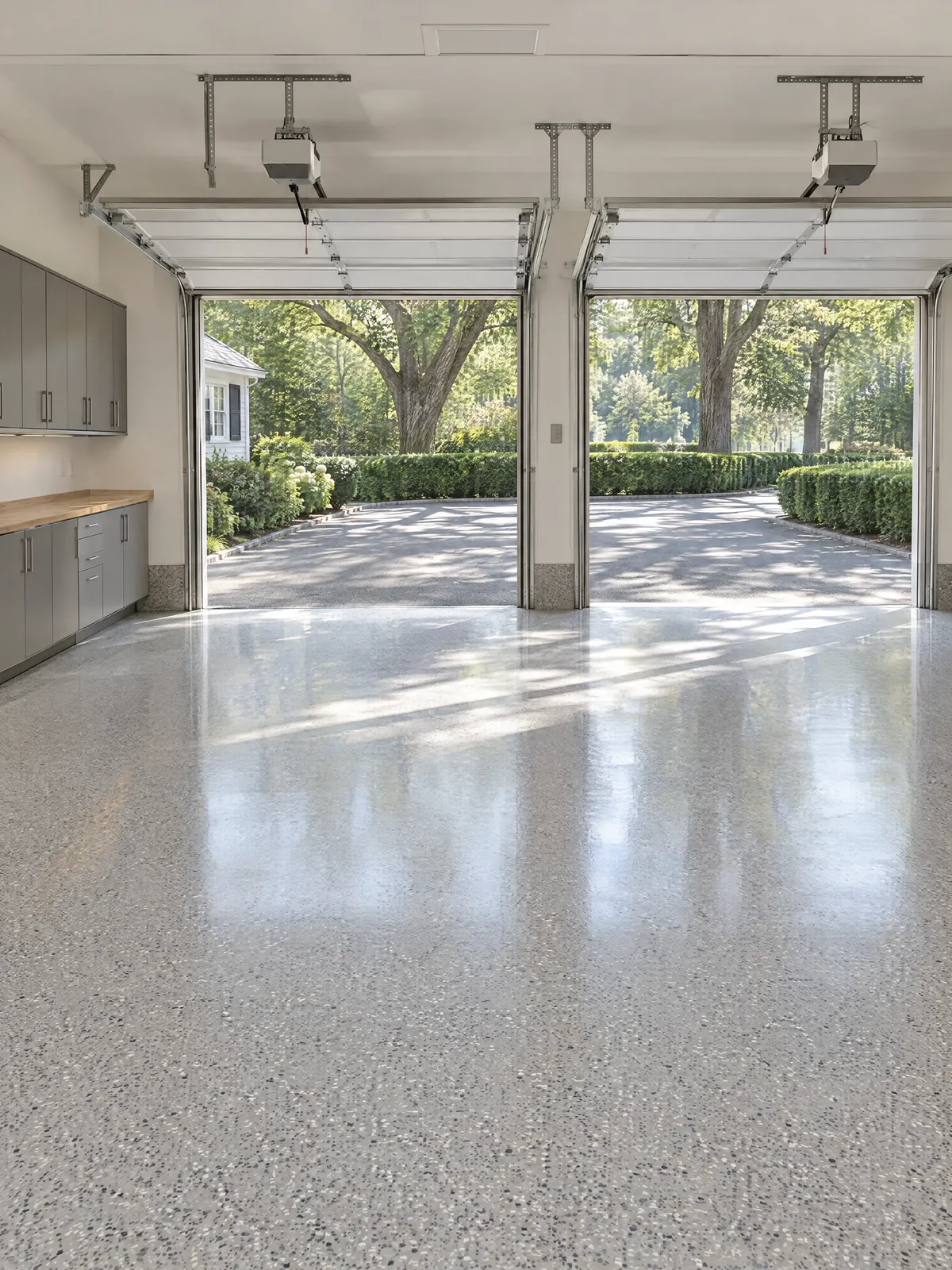
Three familiar South Huntington places carry another hamlet's name in their mailing addresses. Walt Whitman Shops on Route 110 and the South Huntington Public Library on Pidgeon Hill Road give Huntington Station, Birchwood Intermediate on Wolf Hill Road gives Melville, and the Census Bureau's geocoder files all three under the South Huntington census designated place, an area drawn for statistics that has no legal boundary. The Town's "About Huntington" page lists South Huntington among its unincorporated areas, so the Town, not a village, issues permits and sets working hours here.
For 2020-2024, the Census Bureau's American Community Survey estimates 3,476 housing units in South Huntington, 89.1 percent of them one-unit detached, and a median year built of 1958, where the Town's is 1963. For floors, that means garage and basement slabs of that vintage, cars that wait on the driveway while a coating cures, and store floors in the strip centers along Route 110 and Jericho Turnpike. No price survey covers the hamlet, so our cost guide lays out the national ranges, each with its date.
Whether your mail reads South Huntington, Huntington Station or Melville, name the floor, give its measurements and say what covers the concrete now; our visit and slab test come before a free written quote.
South Huntington permits, flood corridors and the ground below
Permits here come from Town Hall. The Town's 311 article "Projects Requiring Permits" leaves permits to village building officials only in Asharoken, Huntington Bay, Lloyd Harbor and Northport, so a South Huntington application goes to the Division of Building and Housing, in Room 115 according to the Town's Building and Housing page. Revised 9/1/2021, the Division's guide for filers puts driveways and slabs on its no-permit list, asks owners to make contact before any work on structures and triples the fees for anything built without a permit.
Water reaches the hamlet from the sky and the road rather than the sea. The Census Bureau's 2024 Gazetteer gives South Huntington 3.415 square miles of land and no water area, and FEMA's flood layer, laid over the census outline on panels effective September 25, 2009, shows only Zone X, FEMA's area of minimal flood hazard. The roads are another matter. The County's FEMA-approved 2020 hazard plan for the Town states that "Old Walt Whitman Road experiences flooding" without naming a stretch, and the Census geocoder puts addresses on that road in both South Huntington and Melville. The County's 2026 draft plan lists Route 110 and Jericho Turnpike among Town corridors "increasingly vulnerable" to hazards such as flash flooding, a warning that names no stretch of either road.
None of that measures the water under a house. The 2020 plan's hazard table puts shallow groundwater at Low for the Town as a whole, and USGS's water-table map for April and May 2016 (SIM 3398) says depth to water generally reflects the topography. Neither is a reading under one slab, and no source we hold says whether the hamlet sits on moraine or on outwash, so we judge each basement here by its own slab.
Garage epoxy in South Huntington: where the cars wait while the floor cures
Vehicle counts run high in South Huntington: in the Census Bureau's 2020-2024 estimates, 35.9 percent of its households have three or more vehicles available, against 29.3 percent Town-wide, and each of those vehicles needs somewhere to stand while a flake floor cures. Rust-Oleum's ESH-06 sheet, for a two-part solvent-based epoxy, keeps vehicles off for 4 days even with the room held between 70 and 80 degrees F at 50 percent humidity, and a colder slab stretches that figure.
The slab comes before the cure. A garage slab poured with its house shows nothing from above of what lies beneath it, so the moisture reading is the first step, by an ASTM F1869 dome or ASTM F2170 probes, followed by diamond grinding to the profile the base coat's sheet names and crack repair ahead of the primer. Our quote gives the vehicle time for each product it lists, and on the day we check it against the slab temperature, so the driveway plan is set before any grinding.

Choosing a garage coating in South Huntington by what the tires carry in
Winter reaches a South Huntington garage on its tires. The Town's stormwater program plan (cover date January 2, 2026) puts about 800 miles of public road in the Town's care and has their winter sand and salt swept up each spring, the north-shore streets and lots first, where the plan seeks the most protection for water bodies. Until the sweepers reach South Huntington's streets, whatever lies on them rides in on the treads.
What the treads bring lands on a film, and films differ. Rust-Oleum's ROC-109 says its one-part paint dries to between 1.0 and 1.5 mils a coat, where Sherwin-Williams' Resuflor Deco Flake SB instructions put a 16 mil grout coat over the flake alone, and Dur-A-Flex reports no effect on its Dur-A-Glaze #4 epoxy after 100 hours of salt spray, one product's test rather than a rule. Between two-part builds, daylight picks the top layer, since Citadel's table gives polyaspartic a Yes for UV resistance and epoxy a No.

Tiles, a mat or a coating for a South Huntington garage you plan to keep
Most homes in the hamlet are lived in by their owners: 89.2 percent of its 3,423 occupied homes, by the Census Bureau's tenure table (B25003) for 2020-2024. An owner who is staying gets the most from a coating, which remains on the concrete when the house changes hands, whereas Swisstrax notes that its tiles can be pulled up and moved to a new home. Tiles and mats still have their places: a garage needed back the same afternoon, a rental, a slab that fails the moisture test.
On a South Huntington slab that fails, tiles can still go down: RaceDeck lays its tiles with no glue and channels them to let air and moisture escape, though it also says a small amount of water works through the seams to the concrete. We sell neither, since we coat, polish and resurface concrete, and when the visit points to tiles or a mat, we say so in writing rather than quote a coating the slab cannot hold.

Installing a South Huntington floor inside Town hours and around storm days
Town rules set the working day in an unincorporated hamlet. Section 141-4 of the Town Code holds the noise of building alteration or repair to weekdays, 7 a.m. through 6 p.m., legal holidays excluded, and our grinders keep that clock. A South Huntington job starts before the grinders do, since a calcium chloride test, as KTA-Tator describes it, needs 60 to 72 hours under its sealed dome; that test goes down days ahead, on a floor already cleared to the walls.
Storm days are a humidity question before they are a water question. The County's 2026 draft hazard plan counts Route 110 and Jericho Turnpike among Town corridors exposed to high-intensity storm events, and Sherwin-Williams' ArmorSeal 1000 HS sheet allows application only at 85 percent relative humidity or less, with the surface no less than 5 degrees F warmer than the dew point. On the morning itself we read the slab temperature, the humidity and the dew point, and if the readings fall outside the sheet's limits, the coat waits for another day.

Polyaspartic for South Huntington garages that can spare their cars one night
In South Huntington the case for polyaspartic is the calendar. Citadel's CDL-15 sheet for its ET-80 polyaspartic lets vehicles back on after 24 hours, the time it gives at 50 percent relative humidity and 70 to 80 degrees F, though its full cure takes 7 days, so a household with three cars can park inside again the following day while the film goes on hardening. Westcoat's EC-101 is slower, at 72 hours to vehicle traffic, so the product named on the quote matters as much as the chemistry.
Citadel requires relative humidity below 75 percent for its RG-80X topcoat, while NOAA's Comparative Climatic Data put Islip's average morning relative humidity, over the year, at 76 percent (1974-2018), an outdoor figure from outside the Town; a damp morning can hold the coat until the air dries. Underneath, Laticrete's FAQs on polyaspartics warn that these coatings "will not breathe", so in a hamlet of older houses the moisture test comes before any choice of chemistry.

South Huntington basements: older slabs, storm runoff and a primer's limits
A basement's age bears on the remedy, not just its moisture reading. Only 5.0 percent of South Huntington's housing units date from 2000 or later in the Census survey for 2020-2024, and an estimated zero from 2020 or later, while Stonhard warns that with a slab more than 25 years old, a moisture barrier may never have been laid. That matters for the fix, because the mitigation primers have conditions of their own: the data sheet for Resuprime MVB, Sherwin-Williams' primer for slabs that read high, requires a functioning vapor barrier and rules out a slab under hydraulic pressure.
Water that enters after a storm is dealt with outside before any primer is discussed, and University of Minnesota Extension points to the gutters, the downspouts and the grade of the ground. A finished room brings in the Town as well: finished basements are on its permit list, and the filing guide wants each one to have a way straight outside, through an egress window or a cellar entry.

Metallic epoxy over older South Huntington slabs, where repairs can show through
A metallic coat is a poor disguise: Westcoat's Liquid Dazzle specification warns that the system may not hide epoxy patching, roughness in the concrete or tracking from a shot blaster. The Census Bureau dates 67.3 percent of South Huntington's housing units to 1950 through 1969 in its 2020-2024 estimates, so a slab here can carry decades of repairs, and where it does, we level or resurface it first, because the pattern forms in the wet resin over whatever lies beneath.
Sunlight raises a second question in a single-story storefront of the kind the Town's 2008 plan describes along Route 110, where daylight can reach the floor. Sika's Sikafloor-264 sheet says its epoxy will discolor in sunlight over time, so a sunlit metallic floor needs a light-stable topcoat, like the satin urethane over Sherwin-Williams' own metallic system. What epoxy does in daylight is set out with its other downsides in our guide.

Store floors on South Huntington's stretch of Route 110 and Jericho Turnpike
The Town's December 2008 comprehensive plan update puts the Walt Whitman Mall, now Walt Whitman Shops, just south of Jericho Turnpike on Route 110, finds strip malls and big-box stores clustered where the two roads meet, and describes Route 110 from Jericho Turnpike to Melville's Pinelawn Road as mostly smaller single-story strip centers and free-standing stores of the mid to late 20th century, with one property zoned C-11 Automotive Service Station. That stretch has addresses in both South Huntington and Melville by the Census geocoder, and nothing we hold says on which side of the line the C-11 lot sits, so we place it in neither hamlet.
A store that trades on weekdays gets little room from Town Code section 141-4, which confines building work to weekdays unless the Town grants a discretionary Saturday permit; under section 87-23(H) that permit costs $750.00 for each Saturday. So a commercial job here is planned around the store's closings and sized to its use: broadcast quartz or flake under shoes and carts, an aggregate-filled mortar under heavy wheels. The Town's "About Huntington" page puts the corridor's major business area primarily in Melville, and our Melville page covers those floors.

Polishing a South Huntington slab instead of coating it, and when not to
A polish puts the slab's own top layer on show. The Concrete Polishing Council's 2023 statement on weak surfaces quotes the ACI 310.1-20 requirement that the surface rate above 4 in Mohs hardness, and NRMCA's CIP 1 traces soft, dusting tops to finishing while bleed water stood on the slab or to short curing; on an older South Huntington slab, no record rules either out. Hardness is checked on the slab itself before we offer a polish, and a weak surface may take a densifier.
Not every floor in the hamlet should be polished. A garage that has parked cars for decades is a poor candidate, since oil and grease, a Sherwin-Williams article on peeling floor coatings warns, sink into the slab and resist cleaning, and a polish would leave those stains in plain view. A basement, or a shop slab freed of old tile along Jericho Turnpike, is likelier, and the densifier adds little to the closing: Prosoco's Consolideck LS sheet says most floors can take traffic within an hour of treatment.

Resurfacing South Huntington's oldest slabs before anything goes on top
Older floors are a minority in the hamlet but a real one: the Census Bureau's 2020-2024 year-built estimates put 175 South Huntington housing units at 1939 or earlier and 208 more in the 1940s. We look first at the garage apron, where frost and de-icing salt work on the surface, and listen for a hollow ring under a hammer, the sign of what NRMCA's CIP 20 calls delamination. For a sound slab with a worn top, Quikrete's data sheet for its Re-Cap resurfacer allows a build from a 1/16 inch feathered edge up to 1/2 inch, with no single layer thicker than 1/4 inch.
CTS Cement does not recommend its own Rapid Set TRU self-leveling topping where freezing temperatures or deicing salts are expected, and NOAA's 1991-2020 normals put the normal January low at the Centerport station, inside the Town, at 24.5 degrees F, so a topping of that kind stays in heated rooms. Wolverine Coatings' bulletin doubts that a slab which is crumbling, rocking, heaving or sinking can be coated without repair, and past that point we say so rather than sell resurfacing as the cure.

Questions
South Huntington questions: permits, road flooding and the Birthplace
Who issues the permit for a South Huntington house whose mail says Huntington Station or Melville?
The Town, through its Division of Building and Housing at Town Hall, whatever the mailing city: none of the three names is among the four villages that the Town's 311 permit article leaves to their own building officials. For floors, the Division's filing requirements (9/1/2021 revision) put slabs on the no-permit line without a word on coating one, while finished basements and garages appear on the Town's permit list. When a coating belongs to either kind of project, the Division hears from us before any work starts.
Does the flooding reported on Old Walt Whitman Road mean a South Huntington basement will take water?
Not by itself. A resident survey in the County's 2020 hazard plan reports flooding on Old Walt Whitman Road, whose addresses the Census geocoder splits between South Huntington and Melville, and the 2026 draft warns that Route 110 and Jericho Turnpike are growing more exposed to flash flooding. Those describe streets in storms, and FEMA's maps, effective September 25, 2009, show only Zone X inside the hamlet. At the house we look at the gutters, downspouts and grading first, then read the slab with in-slab probes or a calcium chloride dome before naming a primer or a system.
Does the Walt Whitman Birthplace put South Huntington floors under historic review?
Not for interior floor work, under the Town's rules. The Birthplace, a farmhouse that the State's page for the historic site says Whitman's father built about 1819, stands on Old Walt Whitman Road on the census line between South Huntington and West Hills. Town Code section 198-42 places the Whitman Historic District on West Hills Road and Chichester Road in West Hills, and none of the entries we could read names South Huntington, though our copy of the official text was incomplete. The Town's 2018 preservation guide adds that interior alteration permits are not reviewed by its Preservation Commission.
Nearby hamlets we cover
South of Jericho Turnpike, Route 110 carries on into Melville, and the Whitman Birthplace stands on the census line with West Hills.