Service area
Dix Hills Epoxy Flooring: Garage, Basement and Commercial Floors
Each Dix Hills slab is tested for moisture and ground before we coat it, and the price for your floor comes in a written quote.
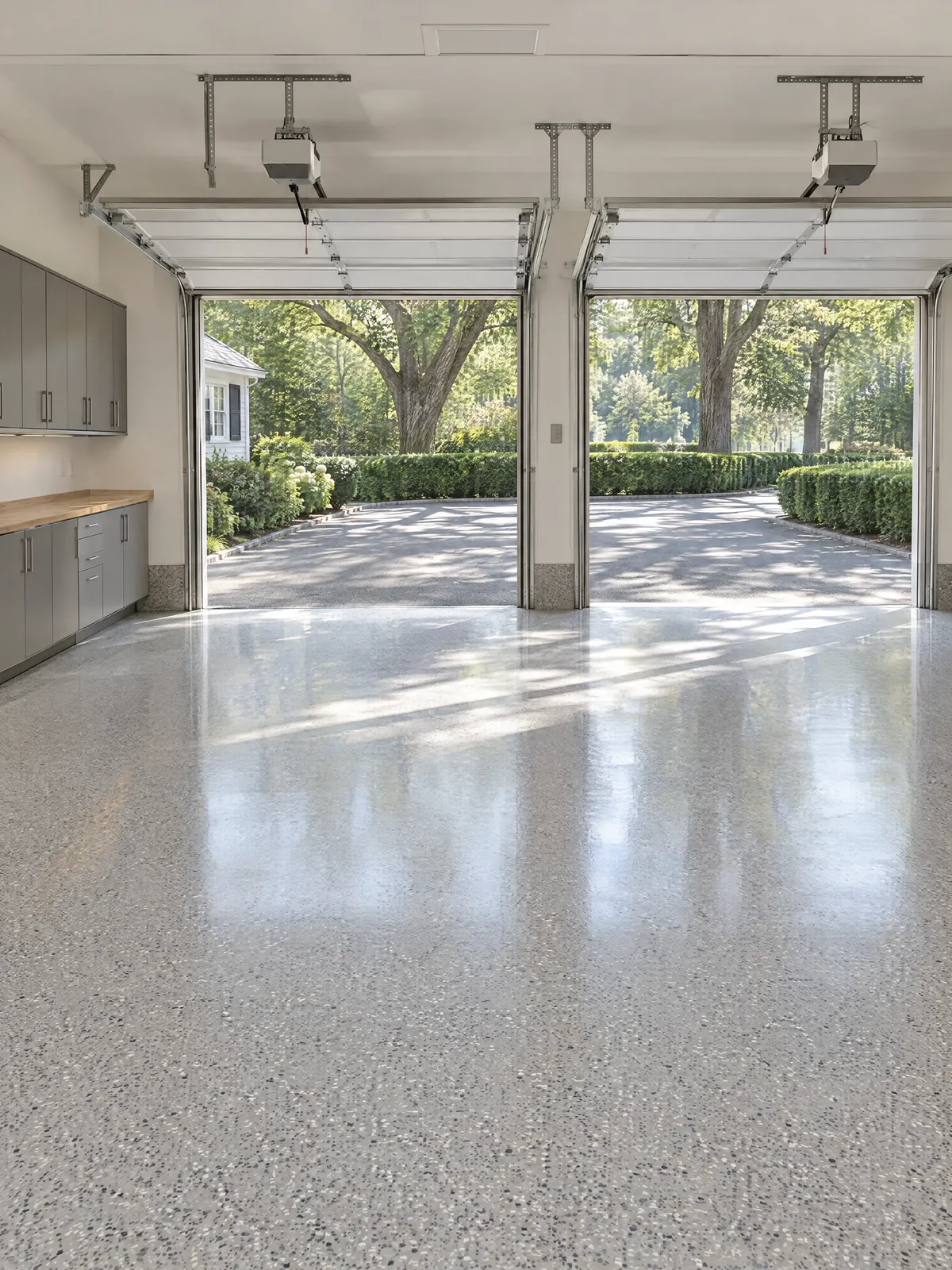
We coat garage, basement and commercial floors in Dix Hills, a Town of Huntington hamlet among glacial hills. In its 2020-2024 estimates, the Census Bureau's American Community Survey gives Dix Hills 8,067 housing units, a one-unit detached share of 94.8 percent, a median year built of 1970 and two or more vehicles in 83.5 percent of households, the highest such share of any hamlet or village on our service-area list.
The survey's figures point to garage slabs and basements from the 1960s and 1970s; our Huntington floor coating data page counts the hamlet's housing by decade. The USGS's 1964 Water-Supply Paper 1669-D on the Huntington-Smithtown area has the West and Half Hollow Hills breaking the Ronkonkoma moraine's ridge in central and southern Huntington, without naming Dix Hills, and Suffolk County's 2006 draft impact statement on vector control and wetlands names Dix Hills, with West Hills, as an interlobate glacial feature.
The larger floors in our sources are institutional: Clark Gillies Arena and the pool at Dix Hills Park, and Five Towns College. Every floor we coat, large or small, starts with a reading from its slab.
Give us the room, its size, the age of your Dix Hills house and what is on the slab; a visit and a slab test come before our written quote.
Permits, deep groundwater and rezonings in Dix Hills
Dix Hills has no village government of its own, so its permits are the Town of Huntington's, handled by the Building & Housing Division of its Engineering Services Department at Town Hall. The 2020 Census gives the Dix Hills census-designated place 15.75 square miles of land; a CDP is a statistical area, not a legal boundary. The Town's 311 permit list and its filing guide, revised 9/1/2021, are silent on coating a floor, so a job near a listed item, a finished basement for one, starts with our question to the Division.
USGS Water-Supply Paper 1669-D tabulates two Dix Hills Water District supply wells in upper Pleistocene deposits: at one, whose measuring point at grade stands 195.8 feet above sea level, water was 135 feet down in May 1958; at the other, 127.8 feet below the reference point on October 23, 1953. Two USGS readings from the 1950s settle nothing about the slab under a given house. The County's 2026 draft hazard plan gives the Town's list of flood-prone areas (Makamah Beach Road, Knollwood Road, New York Avenue) without placing any of them in Dix Hills.
Neither the Town's 2018 preservation guide nor Town Code section 198-42 describes a historic district in Dix Hills. Two rezonings in the record concern new building: the Town's Horizons 2020 plan (July 2008 draft) records the 382-acre former Long Island Developmental Center in Dix Hills redeveloped as The Greens at Half Hollow, and in 2017 the County Planning Commission reviewed DeLalio-Dix Hills, a Town referral to rezone Deer Park Avenue land from R-40 (Residential 40,000 SF) to R-3M for an 86-unit senior condominium. The County's 2026 draft plan lists The Seasons at Dix Hills, 86 units on Deer Park Road, as complete; neither source says the two are one project.
Garage slabs
Epoxy on Dix Hills garage slabs from the 1960s and 1970s
Two decades built much of Dix Hills: the 2020-2024 American Community Survey, in the Census table on our data page, dates 36.5 percent of the hamlet's housing units to the 1960s and 22.6 percent to the 1970s. Stonhard, a maker of resin floors, notes the risk that a slab over 25 years old went down without a moisture barrier; garage slabs from those decades are far older, so each gets its own moisture reading before any epoxy is mixed.
Once the slab is read, we grind to the system's profile (Sherwin-Williams' Form G-1 sets its own flake systems at CSP 5), fill cracks and rebuild any scaled strip inside the door; a reading over the limit adds a moisture-mitigating primer. Then the epoxy base goes down, vinyl flake is thrown into it until no wet resin shows, and a clear topcoat seals it. Westcoat's EC-36 epoxy sheet keeps wheels off for 72 hours at 72 degrees F, longer on a colder slab. National prices by garage size are in our cost guide.

Choosing a system
Where three cars park: choosing the coating for a Dix Hills garage
With three or more vehicles in 37.0 percent of Dix Hills households, by the 2020-2024 American Community Survey, a garage closed for a cure sends several cars to the driveway, so return to service is the first filter. Citadel's comparison table, both figures marked ambient dependent, puts epoxy's full return to service at 36 to 48 hours and its polyaspartic coat's at 24, though epoxy keeps the longer working window, 20 to 60 minutes to the polyaspartic's 20 to 40.
Where daylight through an open door reaches the floor, Citadel's chart rates epoxy's UV resistance No and its polyaspartic's Yes, so a clear polyaspartic coat goes over the epoxy base. Where warm tires roll in every evening, a thin acrylic paint is out, because Sherwin-Williams does not recommend its ArmorSeal Tread-Plex for floors that see hot tire pickup. Every option sits on the moisture reading, and Citadel's own table calls epoxy and its polyurea base coat alike not intended for damp concrete.

Coating or not
When a Dix Hills garage should get tiles or a mat, not a coating
Tiles and mats are not our trade, yet for some Dix Hills garages they are the better floor, and we say so. Here ownership tilts the choice toward a coating: the 2020-2024 American Community Survey counts 95.9 percent of the hamlet's occupied homes as owner-occupied, and a coating stays on the slab when the house is sold, while Swisstrax pitches its tiles as able to come along when you move. For cars that come in wet, RaceDeck itself says a small amount of water can make it through its tile seams.
Tiles win in two cases: a slab that fails the moisture test can still carry them, and a garage needed back the same afternoon can have a full floor of RaceDeck tiles laid in 2 to 4 hours, by that maker's figure. A roll-out mat, fixed to nothing, fits a slab whose repair or coating can wait. Neither repairs concrete, so a spalled bay or a scaled apron stays that way underneath. At the visit we name the right floor, even one we do not sell.

The job, in order
Scheduling an epoxy installation in Dix Hills around tests and Town hours
Dix Hills is an unincorporated hamlet, so Town Code section 141-4 sets our working day: alteration and repair work on a building is a noise disturbance unless it happens on a weekday from 7 a.m. through 6 p.m., and the code's weekdays leave out weekends and legal holidays. The moisture test starts days ahead of the crew: KTA-Tator gives a calcium chloride dome under ASTM F1869 60 to 72 hours sealed on bare concrete, and Wagner Meters wants a probe under ASTM F2170 in its hole 24 hours before a documentable reading.
Then the order is fixed: grind with dust collection and a HEPA vacuum, repair, prime, base coat, broadcast, scrape, topcoat, each coat after the interval on its sheet; ArmorSeal 1000 HS wants at least 8 hours between coats at 77 degrees F and 24 at 50, but no more than 7 days. Our sources hold no weather normals for Dix Hills; at NOAA's Centerport station, days reaching 50 degrees F number 12.0 in a normal March and 25.2 in April, outdoors, so in an unheated garage we take our own readings.

A shorter cure
A next-day polyaspartic floor for a busy Dix Hills garage
Where a Dix Hills household's cars cannot wait out an epoxy cure, a polyaspartic floor shortens it. On Laticrete's data sheet for Spartacote Flex Pure, timed at 70 degrees F in air of 50 percent relative humidity, feet can go on in 3 to 4 hours and vehicles in 24. For a garage with no heat, Citadel's CDL-10 gives the RG-80X topcoat an application range reaching down to 30 degrees F, and the sheet warns that cold can slow the cure.
Speed costs working time. Laticrete allows a mixed batch of Flex Pure only 10 to 15 minutes, so we mix small batches and work the floor in a set order. For the solvent-based Flex SB, the same maker holds the slab to 75 percent relative humidity by ASTM F2170, the lowest limit in our data table, and its polyaspartic FAQ says these coatings will not breathe. However far down the groundwater sits, a polyaspartic floor needs a slab that tests dry.

Below grade
Dix Hills basements: deep groundwater, and still a moisture test
Deep groundwater does not make a basement slab dry. USGS Water-Supply Paper 1669-D found water more than 120 feet below the measuring points of two Dix Hills supply wells, in 1953 and 1958, yet in University of Minnesota Extension's account vapor can pass from wetter ground through concrete walls and floors. The County's 2026 draft hazard plan also lists Five Towns College in Dix Hills among colleges whose key risks include shallow groundwater flooding, a risk it states for the group, not for that campus.
The coating's data sheet sets the pass mark: 85 percent relative humidity under ASTM F2170 for Sika's Sikafloor-264, 80 percent under Sherwin-Williams' Form G-1. Above it, Resuprime MVB, a Sherwin-Williams primer, carries ratings of 85 percent at 12 mils and 100 percent at 17, but only over a functioning vapor barrier, which a 1960s house may lack and nobody can check from above. Making the basement into living space is a separate step: the Town's 311 list names the finished basement among projects needing a permit.

Finished rooms
Metallic epoxy in Dix Hills basements and slab-level rooms
A metallic floor stays indoors: Westcoat's Liquid Dazzle specification says interior use only. In a Dix Hills house that means a basement or another room on a slab, and the slab's history shows through, because the metallic coat is a glossy film with no flake in it. Westcoat warns that an epoxy patch, rough concrete or shot blast tracks may still show under its system, so where carpet or tile has come up we grind off what it left and fill low spots before the pigmented base coat.
Daylight and time come next. A Stonhard article updated in August 2025 warns that sunlight can fade and discolor a floor, so a sunny room gets a satin urethane on top, which is how Sherwin-Williams finishes its own metallic system; that system takes light traffic after a day at 75 degrees F, and its maker allows 14 days for full properties to develop. The pattern forms in the wet resin on the day of the pour, so a sample shows the color and the technique, never a copy of your floor.

Public buildings
Locker rooms and campus floors: commercial epoxy in Dix Hills
Beyond the houses, the Dix Hills buildings in our sources are institutional. The Town's page for the Dix Hills ice rink describes Clark Gillies Arena, two full-size NHL rinks in 150 acres of parkland, and its pool page describes the Dix Hills Park Pool as outdoor, 50 meters long and equipped with locker rooms. Five Towns College puts its campus at about 40 acres, with the Sound Gym Arena in its main building, and the Half Hollow Hills Central School District, which lists its administration center on Half Hollow Road in Dix Hills, counts about 7,300 students.
A floor that wet feet cross, as in a locker room, is judged wet: ANSI A326.3, in its 2021 edition, puts the bar for its Interior, Wet category at 0.42, measured as wet dynamic coefficient of friction, unless the maker declares its own value, so such a floor gets aggregate in its topcoat. Where a building can close only on a Saturday, the work needs the Town's discretionary Saturday permit. The Route 110 business corridor, primarily in Melville by the Town's account, is on our Melville page.

The bare slab
Polished concrete in Dix Hills: old basements, oily bays, hard surfaces
A polish adds no film, so the slab has to qualify on its own: quoted by the Concrete Polishing Council, ACI 310.1-20 wants the surface to exceed 4 on the Mohs scale of hardness. In Dix Hills the 2020-2024 American Community Survey dates 133 housing units to 1939 or earlier and 70 to 2020 or later, and the trade sources we cite set no upper age for polishing, so we test hardness at the visit.
A basement slab that tests dry and comes up sound from under old carpet is a candidate for polishing. A garage bay where oil has soaked in for years points the other way: Sherwin-Williams' article on peeling floor coatings says grease and oil soak in and resist removal, and a polish would leave the stain on view. The Council grades the finish from Level 1, flat, to Level 4, highly polished, read before any guard goes on, and its Position Statement #2 reports wet tests above the 0.42 friction threshold even at very high gloss.

Worn concrete
Rebuilding salt-worn garage aprons and tired slabs in Dix Hills
Winter wears a Dix Hills garage slab hardest just inside the door, where meltwater from salted roads meets frost. NOAA's 1991-2020 normals for Centerport, the station inside the Town, count 88.1 nights a year that fall to 32 degrees F or below, and NRMCA's CIP 2 blames de-icing chemicals for worsening freeze-thaw scaling by saturating the surface. The Town's stormwater plan has its spring sweeping lift the winter's sand and salt from roads, north shore first, but not from the garages where tires carried it.
Local damage is cut out and patched; PCA's IS177 wants the concrete at a spall removed to a depth of at least 1-1/2 inches. Where the whole surface has worn, a resurfacer goes over sound concrete: Quikrete's Re-Cap sheet builds from a 1/16-inch feather edge to 1/2 inch in layers of 1/4 inch or less and takes foot traffic after 8 hours and cars after 24. Wolverine Coatings calls a slab that rocks, heaves or sinks an unlikely candidate for a coating until it is repaired.

Questions
Dix Hills questions: deep wells, Vanderbilt Parkway, new condominiums
USGS found water over 120 feet down in 1950s Dix Hills wells; does a basement slab still need a moisture test?
Yes. USGS Water-Supply Paper 1669-D gives 135 feet to water at one Dix Hills Water District supply well in May 1958 and 127.8 feet at another on October 23, 1953, each measured from the well's reference point. Two USGS readings from the 1950s do not measure your slab, and in Sika's knowledge base, moisture vapor emission is natural to any concrete slab. We run the test the coating's own data sheet calls for, ASTM F1869 or ASTM F2170; our basement floor epoxy page explains both.
Is a house on Vanderbilt Parkway in Dix Hills inside a historic district?
Not in the Town documents we have read. Town Code section 198-42 designates the Long Island Motor Parkway, also known as Vanderbilt Parkway, from Half Hollow Road to the Smithtown border, and the Town's 2018 preservation guide says a historic roadway designation covers the road bed only. Neither describes a historic district in Dix Hills, though the guide lists individual landmarks without naming their hamlets. Even on a designated property, the guide says, the Commission looks only at structural changes to the outside of a building, not at interior alteration permits, and coating a garage or basement floor is work inside the building.
When can the floors in a new Dix Hills condominium, such as Stone Ridge Estates, be coated?
Once the concrete has cured and reads dry. The County's 2026 draft hazard plan shows Stone Ridge Estates, a 55-and-over condominium of 116 units on Deer Park Avenue, still being built (another table there spells it Stoneridge). Form G-1, Sherwin-Williams' preparation guide, names 28 days as the concrete industry's curing standard but says excess moisture may need longer to leave, and This Old House's March 2026 cost page asks for 60 days. A slab is ready when its reading falls inside the coating's limit.
Nearby hamlets we cover
Each of the hamlets below has its own page, built from its Census estimates and public records.