Service area
Epoxy Flooring and Floor Coatings for Centerport, New York
Garage floors, basements and worn slabs in Centerport: each slab tested before we choose its coating, then ground to suit it, with the quote in writing.
Centerport is a harbor hamlet in the Town of Huntington and the home of the Vanderbilt Museum, whose history says William K. Vanderbilt II began his waterfront estate here in 1910, on 43 acres; a Town profile of him dates its opening as a museum to 1950. Most Centerport floors are plainer. The Census Bureau's 2020-2024 estimates in the American Community Survey classify 95.0 percent of the hamlet's housing units as one-unit detached houses, so this page is mostly about the garage and basement slabs of family homes.
Those houses are older than the Town's. The same survey puts Centerport's median year built at 1957, against 1963 for the Town of Huntington. From the garage door nobody can see whether a plastic vapor retarder went under a slab that old, so before we name a system we test its moisture, map its cracks and sound its patches for the hollow note of a delamination.
Our weather figures come from NOAA's Centerport station, whose site notes describe hilly, bluffy ground on Long Island's north shore and whose published coordinates sit just outside the hamlet's census boundary, a line the Census Bureau draws for counting rather than for law. Its normals describe the outdoor air, so we take each slab's own temperature on the day.
Describe the Centerport floor for a written quote: the room and its size, roughly when the house was built, and whether it sits low near the harbor or up the hill.
Centerport's rules for a slab: Town permits, flood records, a managed harbor
Centerport is unincorporated, so its building permits come from the Town of Huntington, not a village government: the Town's web page puts the Building & Housing Division, part of Engineering Services, in Room 115 of Town Hall. Its filing guidelines (revised 9/1/2021) list slabs among work needing no building permit, and the Town's 311 knowledge base names a finished basement among projects that need one; neither mentions floor coatings, and the guidelines' own advice is to ask the Building Department when unsure. Village rules differ, as our Huntington Bay page shows. We found no Town historic district in Centerport; its landmarks come up below.
Suffolk County's draft 2026 hazard plan, in its chapter on flooding, puts a date on one Centerport flood: heavy rain from Tropical Storm Elsa on July 9, 2021 brought flash flooding that left several of its streets impassable. The chapter's dam inventory lists the Centerport Harbor Dam (1900), in the Low hazard class, for flood control and stormwater management. The draft's Town annex leaves Centerport off the Town's list of flood-prone areas, and says a building permit flagged as being in a flood zone is sent on to the floodplain administrator.
Centerport Harbor itself is managed water. A USGS water-supply paper of 1964 on the Huntington-Smithtown area lists it among the harbors that break the shore of Huntington Bay, and the Town's page on harbor dredging records that Suffolk County dredged its channel from Northport Bay in December 2014, removing about 48,000 cubic yards for a depth of 12 feet at mean low water. A Town page on stormwater collection upgrades says the Town began developing its Centerport Harbor Stormwater Management Project in 1996; the last question below says how we keep a floor job's dust and waste out of the storm drains.
Garage epoxy for Centerport homes that park two cars or more
Most Centerport households have two or more vehicles: the Census Bureau's ACS table B25044 for 2020-2024 puts the share at 76.2 percent. Their tires bring the road salt in. Under the Town's stormwater plan, spring sweeping of the winter's sand and salt begins on roads and lots near the north shore, Centerport's side of the Town, but nothing sweeps a garage, and the apron inside the door has taken salt and meltwater all winter.
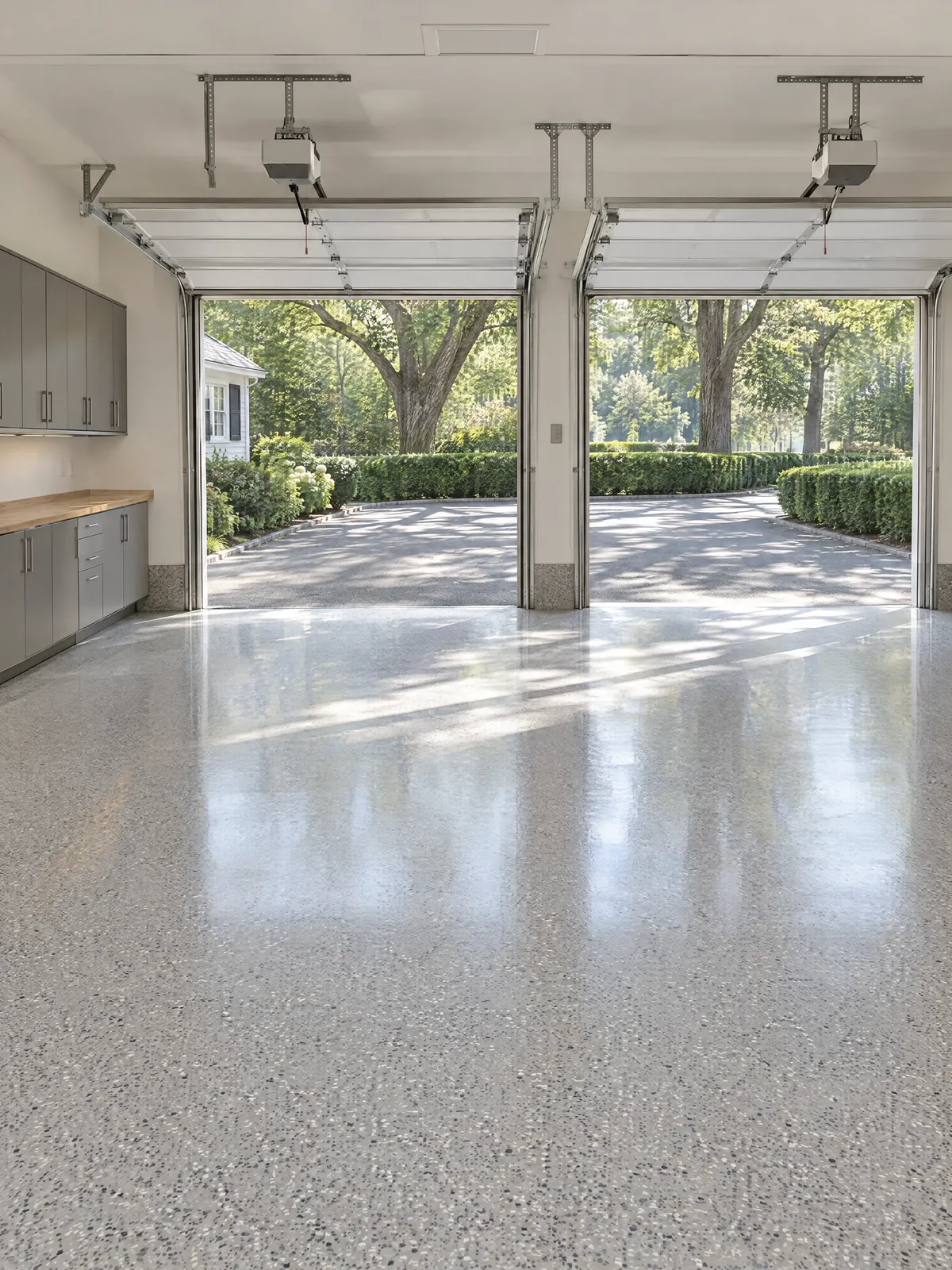
On a slab ground with diamond tooling and repaired, we lay a two-part epoxy base, broadcast vinyl flake into it until no resin shows and seal it under a clear topcoat. Epoxies need warmth: Westcoat's EC-36 sheet, for one, makes 50 degrees F the coldest it may be applied, and NOAA's Centerport normals for 1991-2020 count 25.2 days reaching 50 degrees F in April and 29.7 in October. Without heat in the garage, the slab's own reading picks the day, and colder dates move to a polyaspartic system.

Coating a Centerport garage: film thickness, cure time and old paint
A garage slab under a house of 1957, Centerport's median year built in the Census survey, may already wear paint, a sealer or a kit coating, and Sherwin-Williams says a previously coated floor calls for special preparation. We grind the old film off. What goes back on differs first in thickness: Rust-Oleum's ROC-109 one-part floor paint leaves 1.0 to 1.5 mils dry for each coat, its ESH-06 two-part epoxy 3.5 to 5.0 mils, and Citadel's Polyurea-350 base coat, on its CDL-11 sheet, 5 to 20.
With three or more vehicles at 29.5 percent of Centerport households in the same survey, the cure clock matters as well: ROC-109 keeps cars off a painted floor for 5 days, while Citadel's CDL-10 opens its RG-80X polyaspartic topcoat to vehicles at 24 hours. Epoxy can also yellow: the ArmorSeal 1000 HS sheet warns that epoxy coatings may darken or yellow, so where daylight crosses the floor a polyaspartic or urethane coat goes over the epoxy. Our cost guide holds the national survey prices for each type.

Tiles, a mat or a coating: the choice for a Centerport garage you own
Tiles and roll-out mats lie loose on the slab, and Swisstrax says its tiles can come along to a new home. That counts for less in Centerport, where the Census Bureau's table B25003 for 2020-2024 finds owners living in 96.2 percent of occupied homes. For an owner who is staying, the slab decides: a coating needs it dry and sound, while tiles can go over concrete that fails the moisture test.
Water behaves differently under each. RaceDeck says the seams of its tiles are "tight but not watertight" and recommends hosing salt and road residue away after winter; a coating holds meltwater on a film you can wash; a penetrating silane or siloxane sealer lets bare concrete breathe, though Prosoco's sheet warns that its repellent does not stop water at cracks, defects or open joints. We sell neither tiles nor mats, and when one suits your garage better than a coating, we tell you at the visit.

Epoxy floor installation in Centerport: test days, coat days, season
Slabs more than 25 years old are the ones Stonhard, a maker of resin floors, flags as possibly lacking a moisture barrier, and the Census Bureau's 2020-2024 estimates date 57.9 percent of Centerport's housing units to before 1960. The moisture test therefore leads, and it takes days: KTA-Tator describes the calcium chloride dome of ASTM F1869 sealed down for 60 to 72 hours, so we set any dome at the first visit and choose the system once it is read.
In an unheated garage the season sets the coat days. NOAA's Centerport normals (1991-2020) put even odds on a spring freeze after April 9 and on an autumn freeze before November 10, and we plan unheated epoxy work between those dates, though the slab's reading that morning decides. Each coat waits out its own sheet's recoat time, which stretches as the room cools, and what cold does to a cure is set out in our epoxy pros and cons guide.

Polyaspartic topcoats for Centerport garages coated late in the year
Late in the year is when a polyaspartic system earns its place in a Centerport garage. In an average December at the Centerport station, by NOAA's 1991-2020 normals, only 8.6 days reach 50 degrees F while 17.8 nights fall to 32 degrees F or lower, and the ArmorSeal 1000 HS and Sikafloor-264 epoxy sheets both stop at 50 degrees F. Citadel prints lower limits: 30 degrees F for its RG-80X polyaspartic topcoat (CDL-10) and 0 degrees F for its Polyurea-350 base coat (CDL-11).
Citadel also warns that cold can slow the cure of both coats and asks for a surface 5 degrees F or more above the dew point, so a chilled slab on a damp morning can cancel a day the forecast allowed. And Laticrete's Polyaspartic FAQs say these coatings will not breathe, so a faster cure does nothing for a slab over its moisture limit. Every month's normals are on our floor coating data page for Huntington.

Basement epoxy in Centerport, where groundwater depth follows the land
There is no single depth to groundwater under Centerport. USGS's 2018 water-table map of Long Island, SIM 3398, says the depth to the water table generally reflects the topography, and it colors shallow ground red as areas where "potential substructure flooding is more likely"; its legend begins at less than 11 feet. USGS's 1964 report on the area puts the Harbor Hill moraine's ridge south of the heads of the bays and harbors, so a basement by Centerport Harbor and one on higher ground toward that ridge need not share a depth to water.
So each slab answers for itself. We probe it under ASTM F2170 or seal a calcium chloride dome on it under ASTM F1869, then hold the reading against the limit printed on the coating's data sheet. Over that limit, with no liquid water coming through, we add a primer made to mitigate moisture, used on the terms its own sheet sets and priced separately; water standing on the floor after a storm sends us outdoors first, to gutters, downspouts and grading. Finishing the basement as a room adds a Town permit.

Metallic epoxy for Centerport rooms that are looked at more than driven on
A metallic floor is clear epoxy carrying a metallic pigment over a colored base coat, with no flake to hide what lies beneath. That matters in Centerport, where more of the housing dates from the 1950s than from any other decade: 687 of the hamlet's 2,327 housing units, by the Census Bureau's year-built table (B25034) for 2020-2024. Westcoat says rough concrete, shot blast tracks and epoxy patches may show through its Liquid Dazzle system, so we grind and fill first and name the repairs that may still read through.
Sunlight is the other test. Sika's sheet for its Sikafloor-264 epoxy says it will discolor over time in sunlight, so a metallic floor in a bright room goes under a light-stable topcoat, and Westcoat limits Liquid Dazzle to interior floors. In a basement we read the slab's moisture before anyone picks a pigment, since the metallic coat is epoxy and, in the words of Sherwin-Williams' article on blistering, "Standard epoxy systems are not moisture-tolerant".

Commercial floors in Centerport: Town permits, Saturday work and waste
No official source we have read names a business on Centerport's stretch of Route 25A, so this page names none. A shop, office or studio floor in the hamlet answers to the Town: its 311 list of commercial projects requiring permits includes interior alterations and garages, while Suffolk County's home improvement law is written for one- and two-family houses.
Town Code section 141-4 confines weekday building alteration to 7:00 a.m. through 6:00 p.m. and allows Saturday work only by a discretionary permit, which costs $750.00 for each Saturday under section 87-23(H), so a business that can close only for a weekend needs that permit and a system that cures by Monday. The Town's household hazardous waste facility turns away commercially generated waste, and Town Code Chapter 170, as the County's draft plan summarizes it, aims at paint products and hazardous waste entering the storm sewers, so every container and bag of dust from a business floor leaves with us.

Polished concrete in Centerport: whether an older slab is hard enough
Polishing leaves no film: the concrete itself becomes the floor, so it has to be fit to be seen, and Centerport's houses run old. The Census Bureau's table B25034 for 2020-2024 dates 509 of the hamlet's housing units, 21.9 percent, to 1939 or earlier; the share for the whole Town is 10.8 percent. In the line the Concrete Polishing Council quotes from ACI 310.1-20, the specification sets the bar at a Mohs reading above 4 on the slab's surface, and a soft or dusting surface may need a densifier, or grinding to sound concrete, before it gets there.
In a Centerport house, a polish suits a hard, clean basement or workshop slab whose owner wants the concrete on view. With no opaque layer on top, every old patch and filled crack stays part of the look, and an oil-soaked or door-scaled garage slab is a poor candidate. Our written quote puts the finish in the Council's chart terms: a numbered gloss level and a lettered aggregate exposure class.

Resurfacing Centerport garage slabs that frost and road salt have scaled
CIP 2, from the National Ready Mixed Concrete Association, traces scaling, the flaking of a finished concrete surface, to freeze-thaw cycles made worse by de-icing chemicals. Late winter has both halves of that cycle: for NOAA's Centerport station, the 1991-2020 normals give March 16.7 nights at or below 32 degrees F and 12.0 days reaching 50 degrees F. Frost and salted tires meet just inside the garage door, so that strip is the first we inspect.
Where scaling, pitting or dusting covers most of a sound slab, we resurface the whole floor; where the damage is local, we patch it. The Re-Cap sheet from Quikrete limits that resurfacer to air and slab temperatures from 50 up to 90 degrees F, and on CTS Cement's sheet the Rapid Set TRU topping is not recommended where it would freeze or meet de-icing salt, which leaves it out of an unheated garage here. Where a section rocks, has heaved or has sunk, a new surface would only move with it, and we say so before quoting any coating.

Questions
Centerport questions: landmarks, flooding and the harbor
Is there a historic district in Centerport that limits work on a floor?
We found none: neither the Town's 2018 guide to historic preservation nor the district list in Town Code section 198-42, as far as we could read it, names a historic district in Centerport. The guide does list individually designated landmarks inside the hamlet's census boundary, among them the Velzer House, which the National Register nomination for Huntington's Multiple Resource Area dates to about 1830, and the Vanderbilt Superintendent's Cottage. Exterior changes to a landmark go to the Preservation Commission; the guide puts interior alteration permits outside its review, and a coated garage or basement slab changes nothing on a building's exterior.
Did Tropical Storm Elsa flood Centerport, and how do I check my flood zone?
Elsa's rain on July 9, 2021 made several Centerport streets impassable, by the account in the County's draft 2026 hazard plan, though that draft's list of the Town's flood-prone areas leaves the hamlet off. For one lot, the answer is the federal flood map: Town Code Chapter 168 adopts the maps effective September 25, 2009, and section 168-7 keeps them on file at Town Hall; we could not read them street by street. Whatever the map shows, we test a basement slab before choosing anything, and where liquid water comes up through the floor, it has to be stopped before any coating goes down.
How do you keep grinding dust and leftover coating out of Centerport Harbor?
By never letting either become runoff, which matters here: the Town's stormwater page places the Centerport sub-watersheds beside significant shellfish resources. Our diamond grinders feed a dust collector, nothing is hosed down a driveway, and every bag of dust, rag and container goes away with us; Town Code section 133-1 has whoever is paid for a home improvement take the waste off the premises. Your own leftover two-part product is harder to place: PaintCare, which runs the State's paint take-back program, lists two-component coatings among what it refuses, and epoxy is missing from the accepted list at the Town's household hazardous waste facility, so phone the Town first.
Nearby places we cover
The MTA lists no Centerport station, and a Town-hosted history of the railroad's 1868 arrival says the stop first called Centerport Station is today's Greenlawn station, which our Greenlawn page covers.