Service area
Epoxy Flooring and Floor Coatings in Greenlawn, New York
Garage, basement and shop floors in the hamlet that grew up around Centerport Station, tested for moisture and ground to a profile before any resin is mixed.
Greenlawn grew up around a railroad stop. The Town-hosted history of the railroad's arrival says the hamlet formed at the station first called Centerport Station, now Greenlawn on the MTA's Port Jefferson Branch, where the station map labels Broadway, Boulevard Avenue, Pulaski Road and Railroad Street; Centerport has no station. A Town-hosted profile of Samuel Ballton, a grower of pickles and cabbages, says he earned the title Greenlawn Pickle King in 1899 by raising 1,500,000 pickles in one season, and that several houses he built still stand.
Most of today's housing is postwar. In the Census Bureau's American Community Survey for 2020-2024, 54.1 percent of Greenlawn's housing units date from 1950 through 1969, and the median year built is 1963. Greenlawn is a census designated place, drawn by the Bureau for counting and carrying no legal boundary, so these are estimates with margins of error, and they count houses, not garage slabs.
Two local records matter more to a floor here than any average. The County's 2026 draft hazard plan records the August 23, 2022 flash flood that closed Little Plains Road, and a 2010 report in the State Department of Environmental Conservation's file puts groundwater about 160 feet down at the former Hazeltine plant. Neither says what one slab holds, so each Greenlawn floor is tested for moisture and diamond ground, never acid etched. The published national ranges are in our cost guide.
Tell us the Greenlawn floor's size, the house's age, what is on the slab today and whether storm water has ever reached it; we test the slab, then quote in writing.
Permits, flood records and the water table under a Greenlawn slab
Greenlawn is a hamlet, so its floors answer to the Town of Huntington, not a village. The Town's Building & Housing page says that division, part of Engineering Services, issues building permits, and it works from Room 115 at Town Hall. The Division's application guidelines, in the 9/1/2021 revision, place slabs among jobs that need no building permit and ask owners to contact the Department before working on structures. A room can still need one: a 311 article the Town updated on 8/9/2022 lists a finished basement and a garage among residential projects requiring permits and interior alterations among commercial ones, so when a floor is part of finishing a basement or refitting a shop, we ask the Division before we schedule. The Town's 2018 preservation guide and the parts of Town Code section 198-42 we could read name no historic district in Greenlawn.
The water record cuts two ways, and we read both. The flood chapter of the County's 2026 draft hazard plan says that on August 23, 2022 the Greenlawn Fire Department reported flooding throughout the area and Little Plains Road was closed, yet the flood-prone list in the draft's Town annex names only Makamah Beach Road, Knollwood Rd. and New York Ave. Underground, the 2010 soil vapor intrusion report on the Hazeltine site finds mainly sand to about 170 feet below the surface and groundwater at about 160 feet. One property's measurement is not a map of the hamlet, and a list of streets is not a reading of a slab, so each floor gets its own test.
Flake epoxy on Greenlawn's postwar garage slabs, and where the cars wait
The Census Bureau's 2020-2024 survey counts houses and vehicles, not garages, so we start with the houses: it dates 1,422 of Greenlawn's housing units to the 1950s and 1,126 to the 1960s, and finds two or more vehicles at 72.6 percent of households. Neither figure describes a slab, but together they point to the likely job here: concrete that has carried tires and winter salt for decades, under a household that needs room for more than one car.
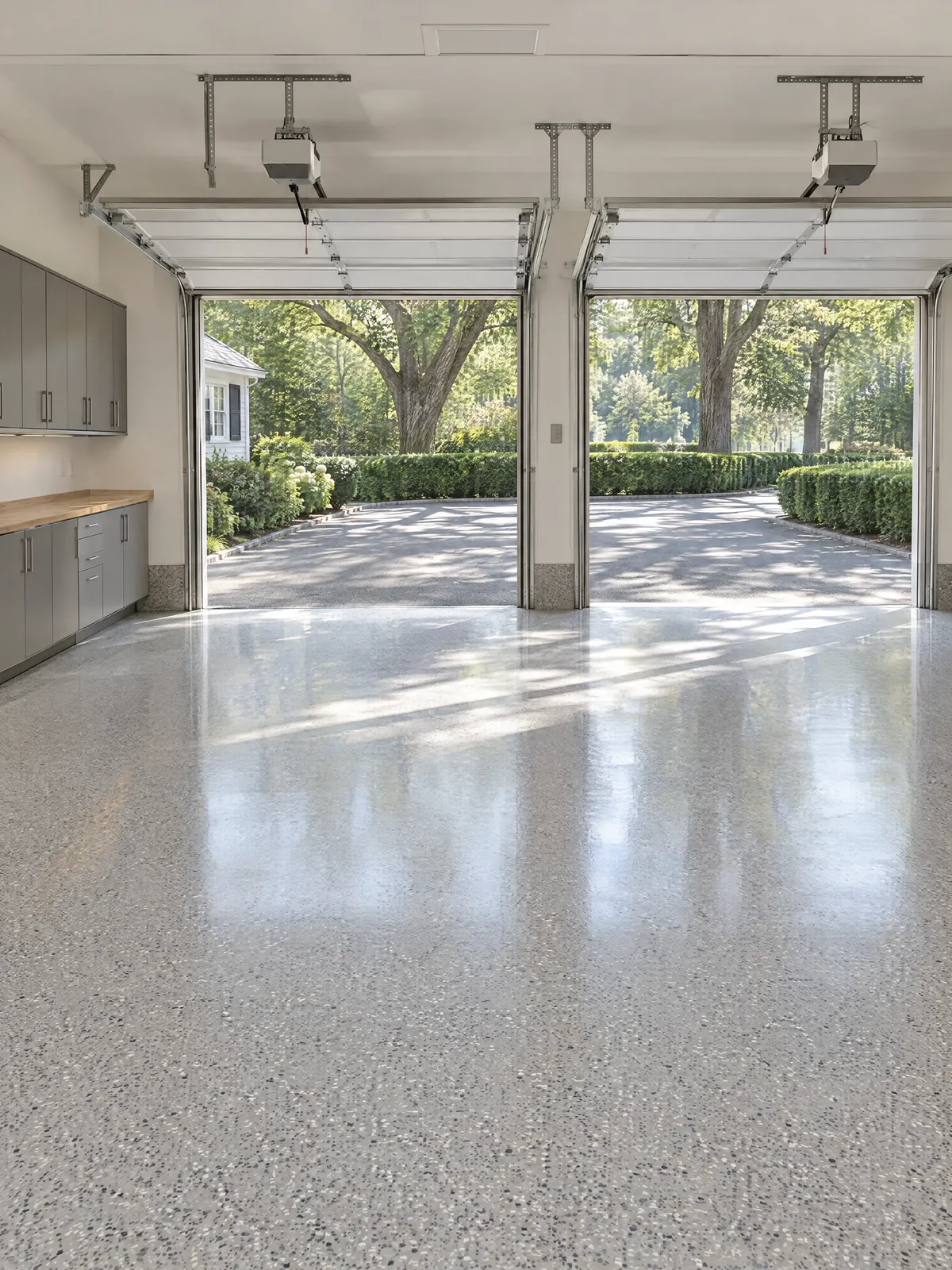
We test that slab before pricing a system, then grind it with diamond tooling and mend a scaled apron or cracked bay before any primer. On an epoxy flake build, the wait is what a Greenlawn household notices: Sherwin-Williams' sheet for its ArmorSeal 1000 HS epoxy holds off heavy traffic for 48 to 72 hours at a temperature of 77 degrees F and for 4 to 5 days at 50, so a cold garage keeps the cars out longer. The polyaspartic section below covers a faster topcoat.

Greenlawn garages that park two cars, and the ones that park none
Not every Greenlawn garage holds a car. The Census survey finds no vehicle at all in 6.0 percent of the hamlet's households, and a garage used as a workshop or for storage asks less of its floor than a parking bay. Where tires roll in every day, a two-part resin earns its cost: Euclid Chemical's bulletin CP-22 ranks epoxy and urethane films as more crosslinked than acrylic cure-and-seal products, and so less prone to tire marks.
For a garage that never sees a car, a lighter product can be enough: a one-part acrylic floor paint, or a penetrating silane or siloxane repellent; Prosoco's sheet for one says treated surfaces still breathe. Tires are what rule the paint out, since Sherwin-Williams steers its acrylic Tread-Plex away from hot tire pickup. A floor painted years ago has the old film ground off first. Epoxy's own limits are laid out in our epoxy flooring pros and cons guide.

A rented Greenlawn garage, or a wet one: tiles, a mat or a coating
Renting is more common in Greenlawn than across the Town: the Census survey finds owners in 83.0 percent of the hamlet's occupied homes, where the Town-wide share is 88.7 percent. That bears on the floor, because a resin film grips the concrete and stays when a tenant moves on. Swisstrax markets its interlocking tiles as able to move to the next house, and a roll-out mat lifts off. We install coatings and sell neither, and we will say when a renter is better served by one of them.
Water is the other question here. Where storm water crosses a garage threshold, tiles pass some of it down: RaceDeck's seams, by its own account, are not watertight. A coating, nonporous in Laticrete's description, holds it on top to be squeegeed out. Neither regrades a driveway pitched toward the door, so we trace the water's path first, and a slab that takes in liquid water is not coated until that is fixed.

How a Greenlawn job runs, from a detached garage to a shared one
A Greenlawn job has a fixed order, and its calendar starts with the moisture test. In KTA-Tator's account, the calcium chloride test leaves its sealed dome in place for 60 to 72 hours, so that visit comes days before the grinders do. Under Town Code section 141-4, building work outside weekday daytime hours counts as a noise disturbance, so our crews work weekdays only, and each coat waits for the recoat time its own data sheet prints.
The building changes the plan more than the coating does. The Census survey finds 85.3 percent of Greenlawn's housing units in one-unit detached houses and 6.5 percent in buildings of five or more units, where a garage or basement may be shared. Suffolk County Code section 563-16 writes its home improvement rules for one- or two-family houses, so in a larger building we plan with whoever manages it, down to where residents park during the cure. Grinding dust and leftover resin leave in our truck, never in a street drain.

Polyaspartic when a Greenlawn household needs its garage back the next day
The Census survey counts three or more vehicles in 27.6 percent of Greenlawn households, and a garage shut for most of a week sends every one of their cars to the driveway or the curb. A polyurea base under a polyaspartic topcoat brings the cars back about a day after the last coat: Citadel's sheets give 24 hours to full traffic for its Polyurea-350 base and to vehicle traffic for its ET-80 topcoat, both figures stated for 70 to 80 degrees F.
That speed comes with limits, which we explain before anyone signs. Citadel's comparison table gives its polyaspartic coat 20 to 40 minutes of working time, so we mix small batches, and the moisture limit can be tighter: Laticrete's Flex SB sheet allows 75 percent relative humidity by probe, against 80 percent in Sherwin-Williams' Form G-1 and 85 on Sika's Sikafloor-264 sheet. A Greenlawn slab that reads over its limit gets a moisture-mitigating primer, with its own cure time, on a separate line of our quote.

Greenlawn basements: groundwater far down, damp soil right under the slab
The Hazeltine report's groundwater depth, about 160 feet, says little about a basement floor. Stonhard writes that the soil under a slab is nearly always damp, at 100 percent relative humidity, and warns that a slab more than 25 years old may have been poured with no moisture barrier beneath it. By the Census survey, only 5.0 percent of Greenlawn's housing units date from 2000 or later, so by house age, most of the hamlet is past Stonhard's 25-year mark.
So the reading comes from your slab: probes set into it, or a sealed calcium chloride dome on it, by whichever test the coating's data sheet uses. Over the limit, a moisture-mitigating epoxy primer goes down first, on its maker's terms, and Sherwin-Williams' Resuprime MVB sheet has two that matter in an older house: a functioning vapor barrier is required, and the slab must not be under hydraulic pressure. A basement that takes in water in heavy storms has the water stopped before any primer.

Metallic epoxy over an older Greenlawn slab: flat first, then color
A metallic floor is a clear film carrying pigment, with no flake to cover what lies beneath, and Westcoat's specification for its Liquid Dazzle system warns that it may not hide epoxy patches or rough concrete. On a basement or den slab poured in Greenlawn's postwar decades, that usually means work before color: cracks and old patches ground flat, sometimes a self-leveling topping first. ARDEX asks 7 days before any coating thicker than 20 mils goes over its K 301, and Westcoat specifies 38 to 42 mils for Liquid Dazzle.
A metallic finish belongs on a floor people look at, such as a den or a basement being finished, and finishing a basement brings the Town permit question above with it. Because the pattern forms as the coat cures, Laticrete's pigment sheet requires mock-ups and field test areas; we make a sample on your chosen base color and pigment, and we tell you plainly that the floor will not match it exactly.

Plant and shop floors in Greenlawn, starting with the I-4 land on Cuba Hill Road
The one industrial site in Greenlawn our sources describe is the former Hazeltine plant, southeast of Cuba Hill Road and Railroad Street, which the 2010 report gives as about 23 acres zoned I-4 light industry with five main buildings. The report says Hazeltine acquired the property in 1957 and made sheet metal, machine parts and electronic systems there, adding Buildings 3 to 5 from 1960 to 1962 and Building 1 in 1971; BAE Systems owned and operated it in 2010, and two soil vapor samples were taken beneath a basement slab in the former Alodine Room.
A floor with that history is read before it is priced: the site's records on the slab and any work beneath it, calcium chloride tests at Sherwin-Williams' Form G-1 spacing (three in the first thousand square feet, one per thousand after) and a build sized to the wheels and chemicals. Uses change here too: the local historical association says a Broadway school became the Harborfields Public Library, and the Town's 311 article lists a change of use among commercial projects needing a permit. Our sources describe no business on Broadway or Pulaski Road.

Polishing a Greenlawn slab: a hardness reading before the first grit
A polish adds no opaque layer, so a Greenlawn slab's patches, stains and old repairs stay in the finished floor. That makes a garage parked in for decades a weak candidate: oil that has soaked into a bay is hard to remove, by a Sherwin-Williams article's account, and scaling at the door, which NRMCA's CIP 2 says de-icers worsen, would show. A basement slab under old carpet, or a shop floor finished to be seen, is the likelier one.
Whether a slab will polish is measured, not guessed. Under ACI 310.1-20, quoted in a Concrete Polishing Council position statement, the slab surface must exceed 4 on the Mohs hardness scale, and a softer one may take a densifier first. The grits then run from coarse metal segments to fine resin pads, and the Council's chart grades the result by distinctness of image in four levels, from flat to highly polished; our quote names the level and the aggregate exposure class in its terms.

Resurfacing a Greenlawn garage or basement slab, not the driveway outside it
The Town's guidelines list driveways beside slabs among work needing no permit, but our resurfacing stays indoors, on garage, basement and shop slabs. Salt reaches a Greenlawn garage on car tires: the Town's stormwater plan says it maintains about 800 miles of public roads and begins sweeping their winter sand and salt in spring, so a season of it has dripped onto the apron first. Our Huntington floor coating data page gives NOAA's freezing-night counts for its Centerport station by month.
How far the repair goes depends on the concrete under the damage. A few spalls or popouts get cut out and filled; a slab scaled or dusting over most of the floor takes a polymer-modified resurfacer or a self-leveling topping on sound concrete; a hollow-sounding patch is a delamination, a skin NRMCA's CIP 20 puts at 1/8 to 1/4 inch. Re-Cap, Quikrete's resurfacer, takes people at 8 hours and cars at 24 by its sheet, and we say in writing which repairs will still show.

Questions
Greenlawn questions: the 2022 flood, the water table and old buildings
The County's draft plan says flooding closed Little Plains Road in August 2022. What does that mean for a Greenlawn floor?
It tells us which question to ask first. The County's draft plan records that on August 23, 2022 the Greenlawn Fire Department reported flooding throughout the area and Little Plains Road was closed, but not which stretch or which lots took water, so it cannot speak for your house. If water reached your garage or basement that day, tell us where it came in and how high it rose. University of Minnesota Extension calls an interior coating a temporary answer to basement moisture and starts outside, with gutters, downspouts and grading; the water comes first and the coating after.
A 2010 report puts groundwater about 160 feet down at the old Hazeltine site. Does a Greenlawn basement still need a moisture test?
Yes. That depth is what a 2010 report gives for one industrial property near Cuba Hill Road, and USGS says depth to water on its April-May 2016 Long Island map (SIM 3398) reflects the topography, so one lot's figure does not carry across a hamlet. Nor is one reading permanent: Simiron's Polyaspartic HS sheet warns that seasonal swings in ground moisture can drive excess vapor through a slab regardless of earlier test results. We test your slab with the method its coating's sheet calls for; the tests are set out on our basement floor epoxy page.
Does a historic listing limit what can be done to a floor in a Greenlawn building?
Not under the Town rules we have read. The Town's 2018 preservation guide lists a Town landmark on Broadway, and the 1985 National Register nomination for the Town's Multiple Resource Area places the Ireland-Gardiner Farm (c. 1750), the Michael Remp House (c. 1770) and the Brush Farmstead (c. 1873) in Greenlawn. The guide confines its Preservation Commission to exterior structural changes on designated buildings and says interior alteration permits are not subject to its review; our sources state no separate rule for National Register listings. In a building that old, we first ask what the floor sits on.
Neighboring hamlets we cover
The MTA's Greenlawn station sheet lists HART's H6 bus for Centerport, Greenlawn, East Northport and Elwood; like Huntington Station, each is a hamlet whose building permits come from Town Hall.