Service area
Epoxy Flooring and Floor Coatings in the Village of Huntington Bay, NY
Garage, basement and club floors in the Village, planned around its permit rules, its working hours and the water on its flood-prone streets.
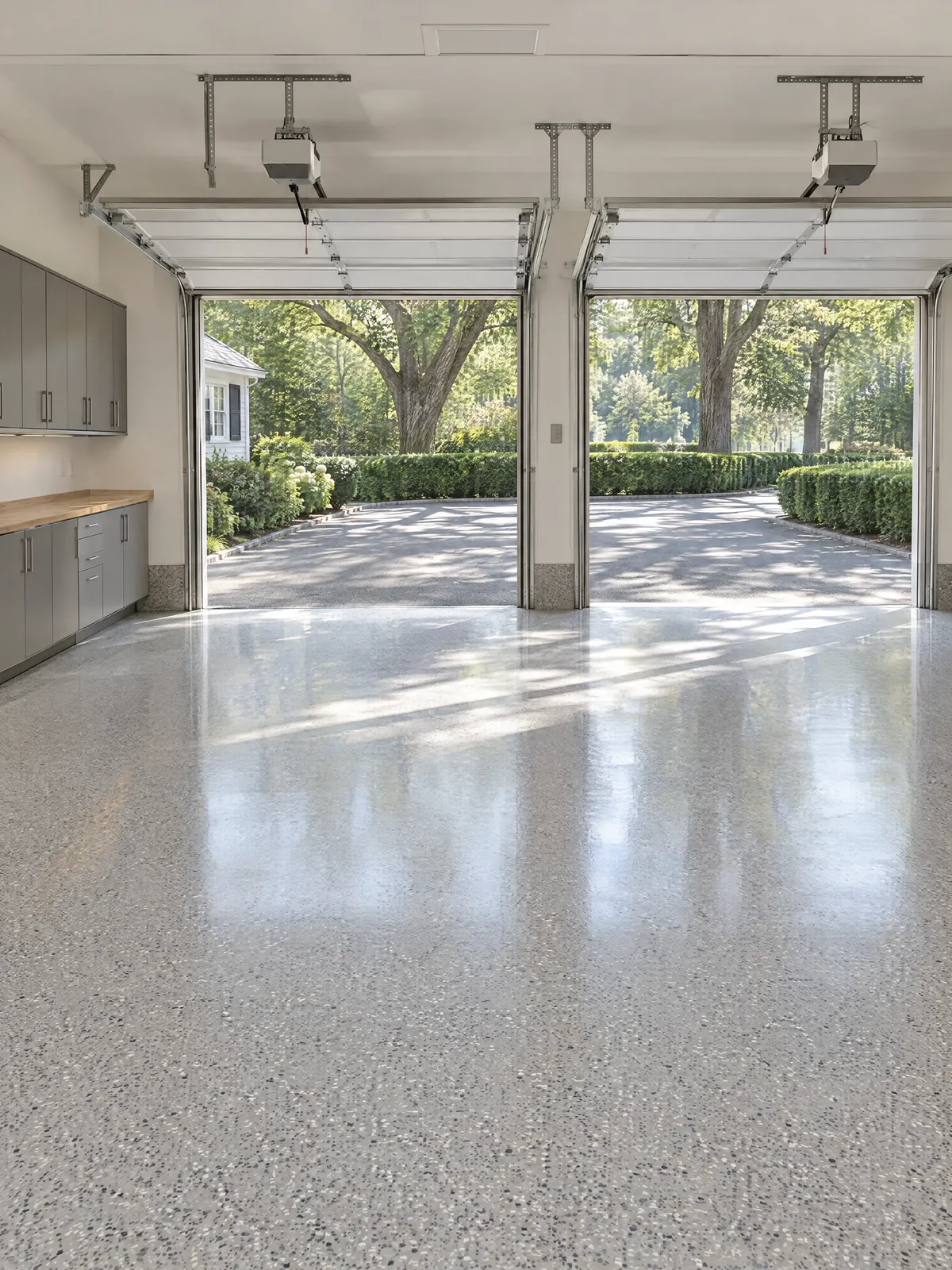
The Town's page on Huntington Bay places the village on the east side of Huntington Harbor and the southern part of Northport Bay, opposite Hobart Beach. It is an incorporated village, zoned residential, and most of its floors are house floors: garages, basements and finished rooms. Census Bureau estimates for the village (the American Community Survey, 2020-2024) find 697 housing units, and in a place this small their margins run wide.
Old houses and new ones are both common here. The same Census estimates date 26.8 percent of the village's units to 1939 or earlier and 22.4 percent to 2000 or later. Stonhard, which makes resin floors, sees a risk that older slabs were laid without a moisture barrier, and a newer garage slab is no sure thing either, as the coating section below explains, so every slab here is tested before we name a system.
Water is the other constant. A 2026 draft chapter on the Village in the County's hazard plan lists four streets as prone to flooding, so the forecast and the Village's rules shape a schedule here as much as the slab does. Our cost guide gathers the national survey prices; the figure for your floor comes in a written quote after a visit and a test.
Tell us the room in your Huntington Bay house, its size, what covers the slab and whether stormwater or groundwater has reached it; we check the Village's permit rule and quote in writing.
Huntington Bay's own permits, working hours and flood streets
Permits here come from the Village, not Town Hall. The Village's section of the County's 2020 hazard plan update dates its incorporation to 1924, and the Town's own 311 list of permit projects hands permit work in the four villages to each village's building officials. As in Lloyd Harbor, the office here is the Village's: the Building Department at Village Hall on Vineyard Road. The Village's building department page has applicants check the fee schedule to learn whether a job needs a permit and sends all waterfront properties to site plan review, and the permit application asks for workers' compensation, liability and disability certificates naming the Village.
The Village keeps its own hours, too. Its code bars building work before 8 a.m. and after 5 p.m. and all day on Saturdays, Sundays and public holidays, a shorter day than the Town allows in its hamlets, where Town Code section 141-4 runs the weekday from 7 a.m. until 6 p.m. Zoning is residential: section 91-7 of the Village's zoning code begins its list of permitted uses with single-family dwellings and churches. The Town's Historic Preservation Commission oversees landmarks and districts in the unincorporated areas only, so its review stops at the village line.
The Village's flood damage prevention law adopts, in section 34-7, FEMA's flood study for Suffolk County and four flood map panels, effective September 25, 2009. In its chapter on the Village, the County's 2026 draft hazard mitigation plan lists Shore Road, Soundview Road, West Shore Road and Bay Road as prone to flooding, and says East Shore Road floods in heavy storms, above all when they coincide with high tides. FEMA figures in the same draft chapter, received January 27, 2026, count 55 flood insurance policies, 92 claims and 12 repetitive-loss properties in the village. A street on the list is a reason to ask about water, not proof that a given slab takes it.
Garage epoxy in Huntington Bay, where stormwater has reached a garage
One entry in the County's 2026 draft plan concerns a garage: stormwater on Bay Avenue, north of Kings Lane, got into a private one, and the Village has installed berms. A flake floor does nothing to keep that water out. In a Huntington Bay garage that has flooded, we ask when and how high the water came, look for the line it left on the walls, and leave the moisture test until the slab has dried out.
The new floor then needs dry days of its own. The Deco Flake II package from Sherwin-Williams says to keep water off the fresh surface for its first 24 to 48 hours, and an epoxy keeps the car out longer: on Westcoat's EC-36 sheet, wheel traffic waits 72 hours at 72 degrees F. So the forecast sets the coating date as much as the calendar does, and a garage that cannot stay empty that long points to the polyaspartic build below.

Coating choices for Huntington Bay garages, including the newer ones
Newer garages get the same test as old ones. Census counts for 2020-2024 show 119 of the village's housing units going up in the 2010s, and a recent date says little about what lies under a garage slab: the International Code Council's 2018 model residential code, on which New York's 2020 residential code was based, exempts garages from its rule calling for a vapor retarder, a polyethylene layer below the concrete. We have not read the State's own text, so a newer Huntington Bay garage is tested as closely as an old one.
What goes down follows the reading: on a dry, sound slab, a two-part epoxy or a polyurea base under a clear polyaspartic topcoat; if the slab reads above what the coating allows, a moisture-mitigating epoxy primer goes under the system, priced on its own line; for bare concrete, a penetrating silane or siloxane, which by Prosoco's sheet for Siloxane PD leaves the surface breathing but will not stop water entering at cracks or open joints. Epoxy's own trade-offs are in our pros and cons guide.

A Huntington Bay garage that may flood: coating, tiles or a mat
Nearly every occupied house here is lived in by its owner, 99.0 percent of them in the Census Bureau's 2020-2024 figures, so the portability Swisstrax advertises for its tiles matters little to an owner who is staying. Size weighs too: section 91-7 of the Village's zoning allows a private garage for up to seven vehicles, or three in the waterfront districts, and every added bay adds tile seams.
Seams matter where stormwater can get in. RaceDeck's own FAQ says its tile seams let a little water down to the concrete, and Swisstrax's drain-through tiles are made to let liquids pass. A coating holds what comes in on one surface, which Laticrete calls nonporous, until it is washed away. Tiles and mats are not ours to sell, and where a Huntington Bay slab fails the moisture test, a tile floor may still be the better answer; if so, we tell you.

Fitting an epoxy installation into Huntington Bay's shorter working day
Recoat windows decide the calendar in Huntington Bay, because the Village's code limits building work to weekdays from 8 a.m. to 5 p.m. Grinding comes first; after it, each coat waits on its data sheet: the ArmorSeal 1000 HS sheet from Sherwin-Williams asks 8 hours before the next coat at 77 degrees F and 24 hours at 50 degrees F, so a base coat rolled out after a morning's grinding gets its next coat on the following working day.
Weekends are closed to building work, so the longest limits count too. ArmorSeal allows as long as 7 days between coats, and a Friday coat can wait for Monday. Sika closes the Sikafloor-264 recoat window at 24 hours at 68 degrees F, and Citadel's Polyurea-350 base, at 70 to 80 degrees F, must be topcoated inside 12 hours or sanded first, so we lay that base early and start no system with a one-day recoat limit on a Friday. Your written schedule gives each coat its day.

Polyaspartic for Huntington Bay garages that cannot stay shut for days
Cars are the case for polyaspartic in Huntington Bay. Census estimates for 2020-2024 give 80.7 percent of the village's households two or more vehicles, where the Town's figure is 71.3 percent, and 26.5 percent three or more, so every day a garage stays closed leaves cars in the drive. Laticrete's Spartacote Flex Pure sheet puts vehicle traffic at 24 hours, under its stated conditions of 70 degrees F with 50 percent relative humidity; Citadel's comparison table gives epoxy 36 to 48 hours before full return to service.
That speed has two costs. Flex Pure's sheet also gives an installer only 10 to 15 minutes to spread each mixed batch, so on a wide floor we work in smaller batches and in step. And a polyaspartic film does not breathe, Laticrete's FAQs warn, so the shorter cure leaves a damp slab's problem where it was. Cold is the other reason to choose one: Citadel's RG-80X topcoat, by its sheet, can go on at 30 degrees F, and NOAA's monthly normals for the Centerport station are on our Huntington numbers page.

Basement floors in Huntington Bay, where groundwater can rise
Basements in Huntington Bay can take water from three sources, the Village's chapter in the County's 2026 draft plan warns: coastal storms, heavy rainfall and rising groundwater. The Village's fee schedule, effective October 15, 2024, lists the permit fee for a finished basement at $.75 per square foot. No coating holds back the water itself. Rust-Oleum prints that its own basement kit is not a waterproofing product, and Sherwin-Williams says not to apply Resuprime MVB, its primer made to mitigate moisture, over a slab under hydraulic pressure, water pressing up from below.
ASTM F1869 itself says its result reflects only the slab's condition on the day of the test, and Simiron's sheet for its Polyaspartic HS cautions that ground moisture shifts with the seasons and can push vapor past a coating's limit whatever an earlier reading showed. So for a village basement we ask when water last came in and where, choose the test the coating's sheet calls for, and treat a slab with water coming through it as a drainage job to finish before any floor goes down.

Metallic epoxy over older Huntington Bay slabs, kept to indoor rooms
A metallic coat is clear resin, spread over a colored base coat and left to level, with no flake to disguise what lies under it: Westcoat says its Liquid Dazzle system may not hide patches or rough concrete, and Sherwin-Williams wants flaws in the slab corrected first, since otherwise they can reflect through the finished floor. Census figures for 2020-2024 put 53.7 percent of Huntington Bay's housing units before 1960, so a slab here may carry decades of cracks and repairs; we grind, fill and tell you which will still show.
Liquid Dazzle is an indoor system by Westcoat's specification, and in Huntington Bay we steer a metallic floor toward a basement or a finished room rather than a garage that can take stormwater. Below grade it needs the same passing moisture reading as any epoxy. Because the pigment disperses into its pattern while the resin cures, a sample board can show colors and technique, never the exact floor.

Club and church floors in Huntington Bay, a village zoned residential
Beyond the houses, the village's other floors are few: the County's 2020 plan update counts one yacht club, one beach and tennis club and five beach associations in Huntington Bay. Section 91-7 also lists churches among the Village's permitted uses, and the Town of Huntington chapter of the 2026 draft names Huntington Bay and Halesite as areas where places of worship face a higher risk of damage from storm surge and tidal flooding. On such floors, grip and drainage come ahead of color.
In the interior wet category of ANSI A326.3, a floor needs a wet DCOF of 0.42 or higher (DCOF being the dynamic coefficient of friction) unless its manufacturer declares a value, and Sherwin-Williams prints a wet DCOF above 0.42, marked with an asterisk, for its Resuflor Deco Flake II system. For a club or church floor that runs wet, we quote a textured broadcast and name each product, with any test value its maker prints. Our Halesite page takes up business floors in that hamlet.

Polished concrete on Huntington Bay's oldest slabs: hardness decides
Hardness, not age, decides whether a slab will polish: the Concrete Polishing Council quotes ACI 310.1-20 as requiring the surface to score more than 4 on the Mohs scale. That matters in Huntington Bay, where the Census Bureau's 2020-2024 counts put 187 housing units as built in 1939 or earlier: an old slab here is judged by its surface, not by its date.
With no coating on top, a polished slab has nothing for rising vapor to blister or peel, a point to weigh where the County's draft plan says groundwater can reach basements. Paint, sealer and old floor coverings come off first; patches stay in view, because a polish lays no opaque layer over them; and by Prosoco's data sheet, a floor densified with its Consolideck LS can usually be reopened to traffic within the hour.

Resurfacing worn Huntington Bay slabs, and when to call an engineer
Huntington Bay's median year built is 1958, plus or minus 7 years, by the 2020-2024 Census estimates, and a slab from that era has had decades of tires, water and repairs. The defect's name sets the repair. Dusting or scaling across most of a floor calls for a resurfacer or topping over the whole slab; where spalls and popouts are few and far apart, each is cut out and filled instead. Some toppings must then be covered: ARDEX's sheet for K 301 says the product must be sealed or coated.
Thin repairs cannot hold a moving slab still: the same ARDEX sheet says thin overlays cannot restrain movement in the structural slab. So we sound the floor for hollow patches and look for any section that rocks, has heaved or has settled. Wolverine Coatings' bulletin calls such a slab a poor prospect for coating until it is repaired and asks for a competent engineer or contractor to look at it where there is doubt; we say so in writing before we quote anything over it.

Questions
Huntington Bay questions: permits, the waterfront and work hours
Do I need a Village permit to coat a floor in Huntington Bay?
Ask the Village's Building Department, because inside the village permits do not come from the Town. The Village points applicants to its building permit fee schedule, effective October 15, 2024, to learn whether a job needs one; it prices finished basements and interior alterations at $.75 per square foot and a detached garage at $3.00 per square foot, and triples the fee for work begun or finished without a permit. We have read no Village rule on coating a floor that already exists, so we put that question to the department before a Huntington Bay job is booked.
Is a waterfront house in Huntington Bay treated differently?
In two Village rules, yes. The Village's building department page sends every waterfront property to site plan review, and section 91-7 of its zoning allows a private garage for up to seven vehicles but holds it to three in the waterfront districts A1, B1, C1 and D1. The County's 2026 draft hazard plan adds a record of damage from flood, wind and winter storms along the West Shore Road waterfront, the Bay Road shoreline and areas next to Huntington Harbor. The Village's page does not say whether site plan review covers a new floor inside an existing house, so that question goes to Village Hall before a date is set.
Can a floor crew work on a Saturday in Huntington Bay?
Not under the Village's code, which bars building work on Saturdays, Sundays and public holidays, and before 8 a.m. or after 5 p.m. on other days. The hamlets differ: there, Town Code section 141-4 allows Saturday work only by discretionary permit, and only from 9 a.m. until 5 p.m., and under section 87-23(H) of the same code each permitted Saturday carries a $750.00 fee. We know of no such permit in Huntington Bay, so club work there is planned for weekdays, and a house job that runs across a weekend pauses from the Village's Friday close until its Monday start.
Nearby hamlets and villages we cover
Lloyd Harbor, like Huntington Bay, issues its own building permits; Halesite and Centerport are unincorporated, and their permits come from Town Hall.